
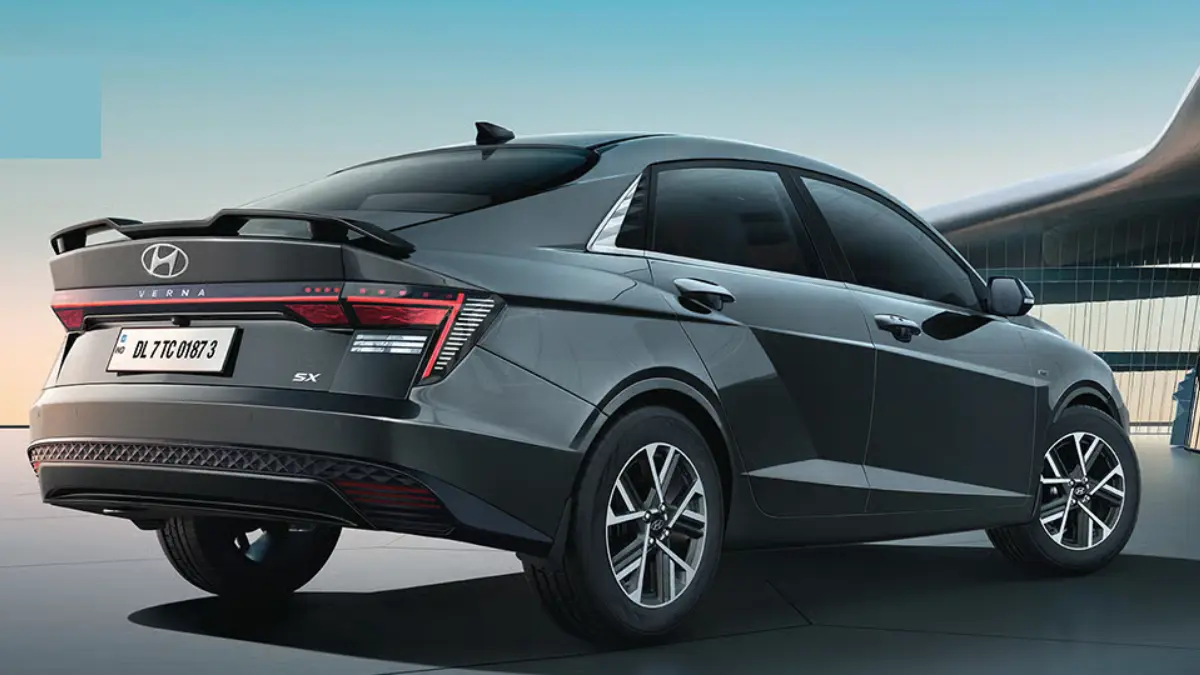
2026 Hyundai Verna Facelift: In an era where SUVs seem to be swallowing the automotive market whole, the mid-size sedan segment is proving it still has plenty of fight left. The Hyundai Verna has always been a lightning rod for conversation—sometimes for its bold styling, other times for its class-leading tech.
New spy shots have just emerged of the 2026 Hyundai Verna Facelift, and they suggest that Hyundai is listening closely to customer feedback. This isn’t just a bumper swap; it’s a strategic refinement designed to reclaim the throne from rivals like the Volkswagen Virtus and Skoda Slavia.
A Cabin That Feels More ‘Premium,’ Less ‘Plastic’
The biggest news lies behind the door handles. While the current Verna’s interior was futuristic, some critics felt it lacked a certain “warmth.” The 2026 model aims to fix that.
The most striking change is the new two-spoke steering wheel, ditching the traditional “H” logo for four minimalist dots—Morse code for “H.” It’s a sophisticated touch borrowed from Hyundai’s high-end EV lineup.
The test mules also revealed vibrant red stitching across the seats and gear shifter, suggesting that the “Turbo” variants will continue to lean heavily into their sporty DNA. With updated brushed aluminum inserts and a more integrated dual-screen layout (10.25-inch displays for both infotainment and clusters), the cockpit feels less like a car and more like a high-end tech lounge.
2026 Hyundai Verna facelift
Smoothing Out the Edges: Exterior Refinements
When the current Verna launched, its “Parametric Dynamics” design divided the internet. It was aggressive, sharp, and unapologetic. For 2026, Hyundai appears to be “growing up” the design.
- The Face: Expect a revised grille with a more sophisticated 3D pattern and a redesigned lower bumper that adds a bit more muscle to the chin.
- The Stance: New 16-inch diamond-cut alloy wheels have been spotted, featuring a “vortex” design that gives the car a sense of motion even when parked.
- Lighting: The signature “Horizon” LED light bar—the car’s most recognizable feature—remains, but with tweaked internals for a sharper, more premium throw of light.
Performance: If It Isn’t Broken, Don’t Fix It
Under the hood, the 2026 Verna is expected to stick with the powertrains that made it a favorite for driving enthusiasts.
The 1.5L Turbo-petrol engine remains the star of the show, pumping out a segment-leading 160 PS and 253 Nm of torque. Whether you prefer the engagement of the 6-speed manual or the lightning-fast shifts of the 7-speed DCT, the Verna remains the “hot sedan” of its class. For those prioritizing efficiency and city commutes, the reliable 1.5L Naturally Aspirated petrol (115 PS) will continue to be the value leader.
The Feature War: Level 2 ADAS and Beyond
Hyundai knows that in this segment, features sell cars. The 2026 Hyundai Verna facelift is expected to double down on safety and convenience:
- Enhanced ADAS: Improved radar sensors for better “Stop & Go” functionality in heavy traffic.
- Ventilated & Heated Seats: A luxury usually reserved for cars twice its price.
- 360-Degree Camera: Now with higher resolution and better low-light performance.
The Verdict: Is It Enough to Beat the Virtus?
The mid-size sedan market is currently a game of inches. In early 2026, Verna sales saw a slight dip while its European rivals climbed. This facelift is Hyundai’s “counterpunch.”
By focusing on interior quality and sophisticated design tweaks, Hyundai is moving the Verna away from “experimental” and toward “executive.” If the pricing stays competitive—expected to range between ₹11 Lakh and ₹17.50 Lakh—the 2026 Hyundai Verna facelift might just be the car that reminds everyone why sedans are still the coolest way to travel.