
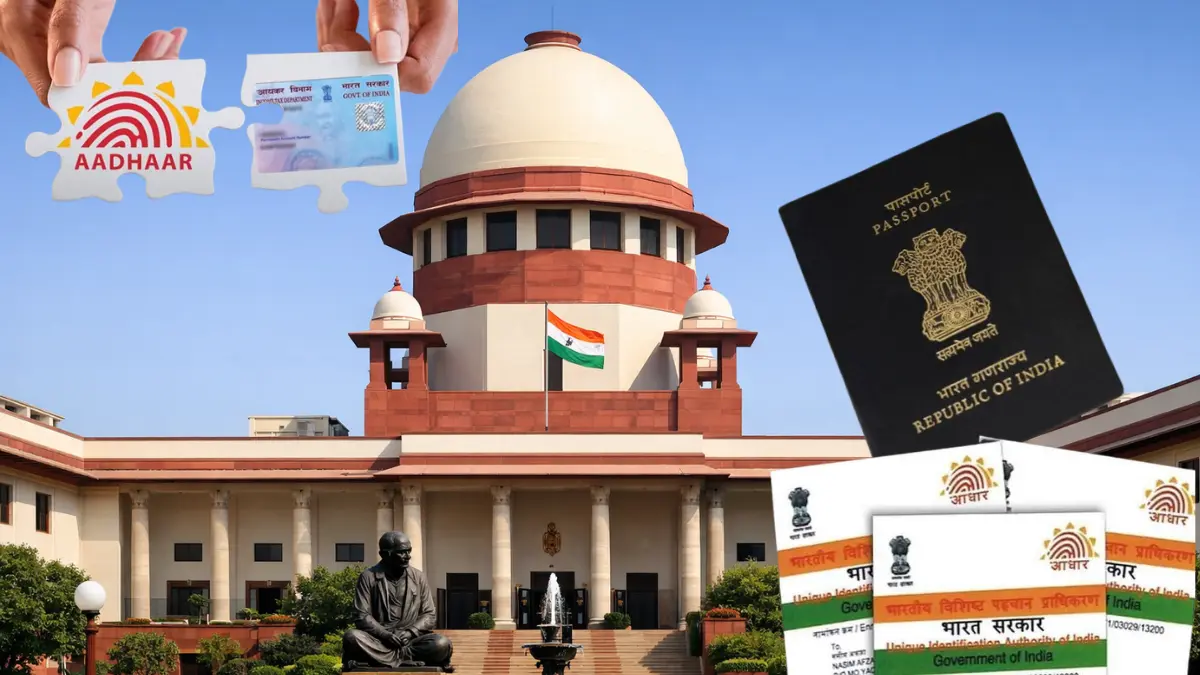
The Supreme Court of India has pointed out that other crucial state services like the Passport Issuance are also placed in the hands of private agencies as they listen to complaints opposing the Aadhaar use on the Special Intensive Revision (SIR) electoral roll. The observation was made when there were arguments against the validity of Aadhaar as a validating document.
This was said by a Bench headed by Chief Justice Surya Kant and Justice Joymalya Bagchi, when the Court heard petitions challenging the voter list revision exercise of the Election Commission of India.
Petitioner Opposes the Aadhaar in Electoral Checking
At the hearing, senior advocate Vijay Hansaria, who represented a petitioner Ashwini Kumar Upadhyay, argued that Aadhaar could not be a valid document in the SIR process. He explained that enrolment of Aadhaar is done by mostly privately run centres, which, according to him, undermines its credibility.
The petitioner insisted that voter lists verification should be based solely on documents that are issued by the government personnel, particularly where the question is those pertaining to democratic rights, like voting.
Passport Issuance Case Cited by Supreme Court
The Supreme Court reacted to the argument by making a direct analogy with passport services.
Justice Joymalya Bagchi noted that even passport issuance is outsourced to the private companies to carry out various tasks such as handling applications, appointments, and facilitation of documents but passports are among the most reputable identity documents in India.
The Bench wondered how the involvement of the private in itself can be used to nullify Aadhaar given that there have been similar models in major government services.
Aadhaar is Considered As A Recognised Identity Document
Once again, the Court pointed out that Aadhaar has always been accepted as a valid identity document, but it does not determine citizenship.
The judges made it clear that the use of Aadhaar in voter list revision does not imply that it is being used as a part of proving citizenship. Rather, it is utilized to help with verification, minimize duplication and improve the accuracy of electoral rolls.
The Bench pointed out that there is a vast difference between identity authentication and citizenship determination as two legal terms.
Election Commission In The SIR Process
The Election Commission of India (ECI) has insisted that the Special Intensive Revision is meant to:
- Eliminate duplicate or fraudulent voter records.
- Update voter data
- Enhance electoral roll transparency.
- Enhance the quality of election.
The Court noted that the documents that are to be provided in the process of SIR are not intended to substitute citizenship checks that are mandated by the current laws.
Denies of Political Bias By Petitioner
To overcome the concern that the voter revision exercise is politically motivated, the petitioner explained that there have been deletions done on the electoral rolls that cut across the electoral parties and it is not targeted at a particular group.
According to him, the purpose of the petition was to have a cleaner and more reputable electoral system and not to achieve political benefit.
Hearing in Supreme Court to Resume
The Supreme Court will further move on to argue out different sides in the next few days. The case should significantly feature in determining how election related processes can be carried out through usage of identity documents such as Aadhaar, without undermining the constitutional protection.
Case Matters
This case is important because it touches upon:
- The privacy and technology dilemma.
- The use of Aadhaar in governance.
- Transparency in the largest democracy of the world.
- The increased utilization of the forms of public-private partnerships in the governmental services.
The ultimate ruling of the Court may affect the future electoral verification process in the whole of India.