
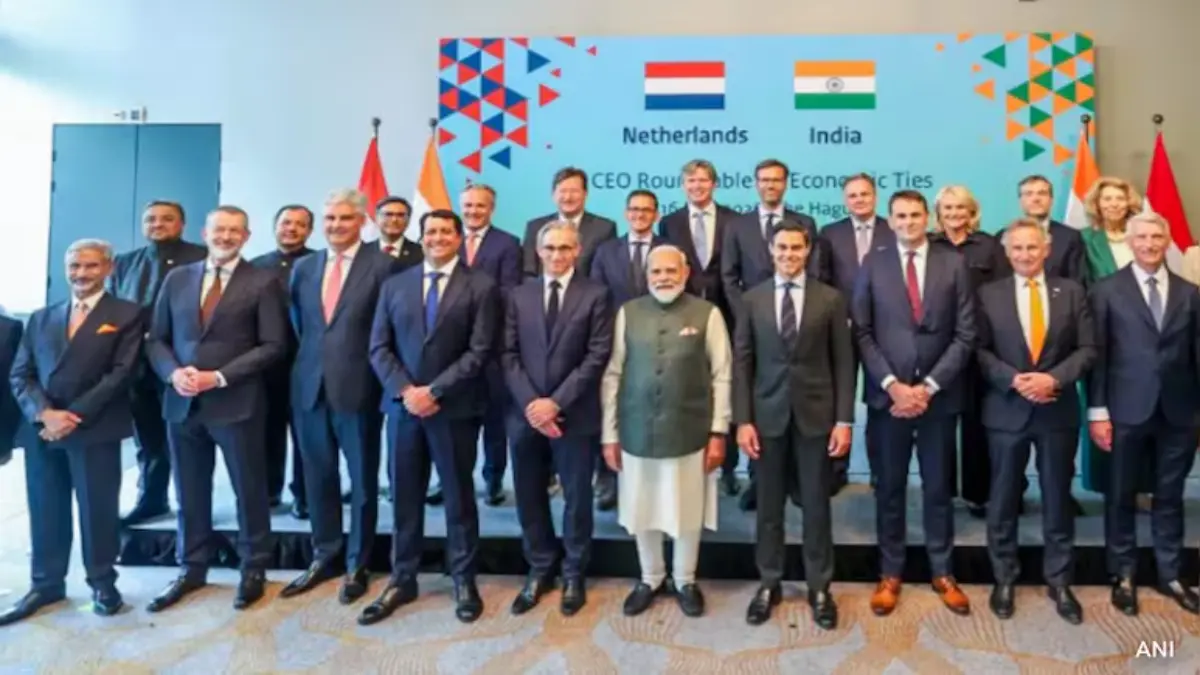
ASML: In a major diplomatic and economic push, Indian Prime Minister Narendra Modi and his Dutch counterpart, Prime Minister Rob Jetten, co-chaired a high-powered CEO Roundtable in The Hague on Saturday. Striking a highly optimistic tone, PM Modi declared that 2026 marks the beginning of a “Golden Era” for India-Europe relations, anchored by the newly concluded historic Free Trade Agreement (FTA) between India and the European Union.
Addressing a room of the Netherlands’ top corporate titans, Prime Minister Modi repositioned India as an unmatched global hub for manufacturing, technology, and clean energy, urging Dutch businesses to “design, innovate, and manufacture in India.”
Dholera Semiconductor Breakthrough
The absolute highlight of the summit was a major commercial breakthrough for India’s tech ambitions. In the presence of both Prime Ministers, India’s Tata Electronics and Dutch tech giant ASML—the world’s most critical supplier of semiconductor lithography equipment—officially signed a landmark partnership agreement.
ASML will actively support the development of India’s first front-end semiconductor fabrication facility (Fab) located in Dholera, Gujarat. This move significantly cements India’s positioning in the global microchip supply chain and serves as a major win for the Make in India initiative.
Elevating Ties to a Strategic Partnership
During the bilateral discussions, India and the Netherlands officially elevated their bilateral relationship to a Strategic Partnership. The leaders introduced three critical future-ready frameworks:
- Green Hydrogen Roadmap: An ambitious joint roadmap aimed at establishing resilient supply chains for renewable energy and clean hydrogen.
- India-EU FTA Realization: Both Prime Ministers pushed for the rapid and robust implementation of the India-EU Free Trade Agreement to build reliable, open markets and secure global supply chains.
- Next-Gen Economic Reforms: PM Modi highlighted that India has altered its “economic DNA” by implementing sweeping next-generation reforms in taxation, governance, and labor codes, alongside opening up tightly regulated sectors like space, mining, and nuclear energy to private participation.
“Today’s India is a symbol of scale and stability. No country in the world can match its speed in infrastructure, clean energy, and connectivity. This is why India is currently contributing 17% to global growth. There can be no better time to invest than today.” > — Prime Minister Narendra Modi
Who’s Who: The Dutch Corporate Giants in the Room
The roundtable featured presentations divided into three specialized clusters: Semiconductors, Tech & Innovation; Infrastructure, Logistics & Maritime; and Sustainability, Energy & Agriculture.
The unprecedented gathering brought together the chief executives of Europe’s most powerful multinational corporations:
| Cluster / Sector | Company | Executive Present |
| Semiconductors & Technology | ASML NXP Semiconductors Prosus | Christophe Fouquet (President & CEO) Maurice Geraets (CEO, Netherlands) Fabricio Bloisi (CEO) |
| Logistics, Maritime & Infrastructure | APM Terminals Port of Rotterdam Damen Shipyards Group Royal IHC Van Oord Royal Vopak | Keith Svendsen (CEO) Boudewijn Siemons (CEO) Arnout Damen (CEO) Derk te Bokkel (CEO) Govert van Oord (CEO) Dick Richelle (Chairman & CEO) |
| Healthcare, Energy & Agri-Tech | Philips Power2X Heineken KLM Royal Dutch Airlines Randstad Rijk Zwaan Royal HZPC Group | Roy Jakobs (CEO) Occo Roelofsen (CEO) Dolf van den Brink (Chairman & CEO) Marjan Rintel (President & CEO) Sander van’t Noordende (CEO) Martijn Eggink (Managing Director) Hans Huistra (CEO) |
Value Analysis: Why the Netherlands Matters to India
For economic analysts, this visit highlights a profoundly vital corridor. The Netherlands is currently India’s largest investor from Europe and its second-largest European trading partner. Over 300 Dutch companies are actively embedded in the Indian economy.
By capturing partnerships with entities like ASML (semiconductors), Port of Rotterdam (maritime logistics), and Power2X (green energy), India is targeting precise technological dependencies. Rather than just inviting capital, India is pulling in the foundational, specialized intellectual property required to drive its next generation of economic maturity.
What’s Next on the Agenda? ASML
The Netherlands was the second leg of PM Modi’s extensive five-nation official tour aimed at deepening bilateral trade, defense, and renewable energy ties. Having arrived from the UAE, Prime Minister Modi has departed The Hague and is heading to Sweden for the third leg of his tour, which will also include official visits to Norway and Italy.