
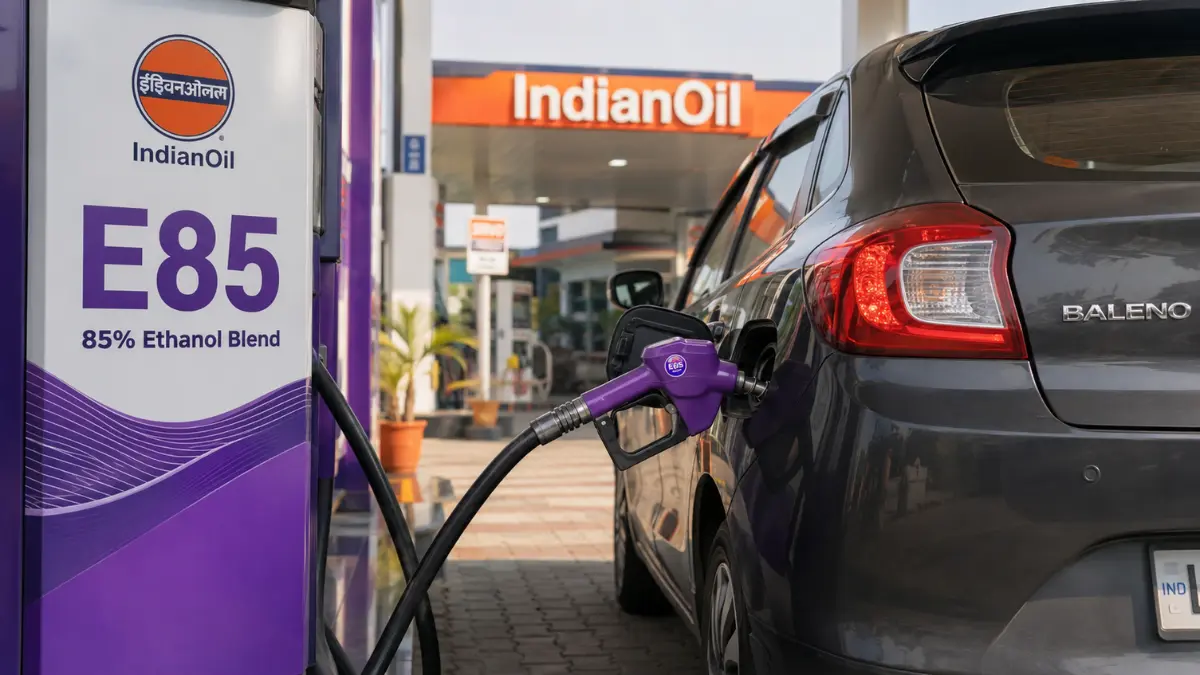
India’s aggressive push toward sustainable energy reached a massive milestone this week with the official commercial launch of E85 fuel in the national capital. Rolled out in the presence of Union Ministers Nitin Gadkari and Hardeep Singh Puri, the high-ethanol blend is hitting select pumps at an eye-catching ₹82.12 per litre.
At roughly ₹20 to ₹30 cheaper than standard petrol (which hovers above ₹100/litre in major metros), E85 looks like an absolute steal on paper. However, before you rush to line up at the pumps, automotive experts are urging motorists to look closely at the fine print regarding vehicle compatibility and actual cost-per-kilometre math.
What Exactly is E85 Fuel?
While the standard fuel currently sold across India is E20 (a blend of 20% ethanol and 80% petrol), E85 is a completely different beast.
E85 Composition: It contains up to 85% ethanol derived from agricultural feedstocks (like sugarcane and surplus grain) and only 15% conventional petrol.
Because ethanol has vastly different chemical properties than petrol—including a higher alcohol content that can be corrosive to standard rubber gaskets, fuel lines, and aluminum components—it cannot be used in a standard combustion engine.
The Big Catch: Can Your Car Run On It?
The short answer for 99% of Indian motorists today is: No.
Even if your car was purchased recently and is certified as “E20 compliant,” it cannot safely handle E85. Running this high-ethanol blend in a conventional engine can cause severe long-term mechanical degradation, fuel system corrosion, and immediate engine performance issues.
To use E85, you need a Flex-Fuel Vehicle (FFV). These specialized cars feature smart sensors and modified fuel systems that automatically detect the exact mixture of ethanol in the tank, instantly recalibrating the engine to run smoothly on anything from 100% standard petrol to 85% ethanol.
While manufacturers have spent the last few years showcasing prototypes—most notably the Maruti Suzuki Wagon R BioFlex (FFV)—mass-market flex-fuel cars are still a rarity on Indian roads.
The Efficiency Paradox: Will It Actually Save You Money?
The biggest consumer misconception surrounding E85 is that a lower price per litre automatically guarantees cheaper road trips. The underlying physics of alternative fuels tells a very different story.
Ethanol has a significantly lower energy density than petrol. This means your engine has to burn more of it to produce the same amount of power. Globally, in mature flex-fuel markets like Brazil and the United States, switching to E85 results in a 20% to 30% drop in fuel economy (kmpl).
When you map out the real-world math, the financial advantage quickly evaporates:
| Fuel Type | Price per Litre | Hypothetical Mileage | Estimated Running Cost |
| Standard Petrol | ₹102.12 | 15.0 kmpl | ₹6.81 per km |
| E85 Ethanol | ₹82.12 | 11.25 kmpl (25% drop) | ₹7.30 per km |
As the data shows, despite E85 being roughly 20% cheaper at the nozzle, the drop in efficiency can actually make your cost-per-kilometre higher than running on standard petrol.
The Big Picture: Why E85 Matters Anyway
If it might not save individual drivers money immediately, why is the government backing it so heavily?
The launch of E85 isn’t just about consumer savings; it is a macroeconomic and environmental play. By scaling up domestic ethanol production, India aims to achieve three crucial goals:
- Slash Import Bills: Lowering the country’s multi-billion-dollar reliance on foreign crude oil imports.
- Support the Agrarian Economy: Giving local farmers a massive, steady market for sugarcane and grain surpluses.
- Greenhouse Initiatives: Significantly cutting down net carbon tailpipe emissions to meet national climate targets.
The Bottom Line
The arrival of E85 at ₹82.12 per litre is an incredibly promising tech showcase for India’s green transition. However, until flex-fuel cars become common in dealerships and E85 pumps expand far beyond select urban locations, it remains a preview of tomorrow’s commute rather than a solution for today’s driver.