
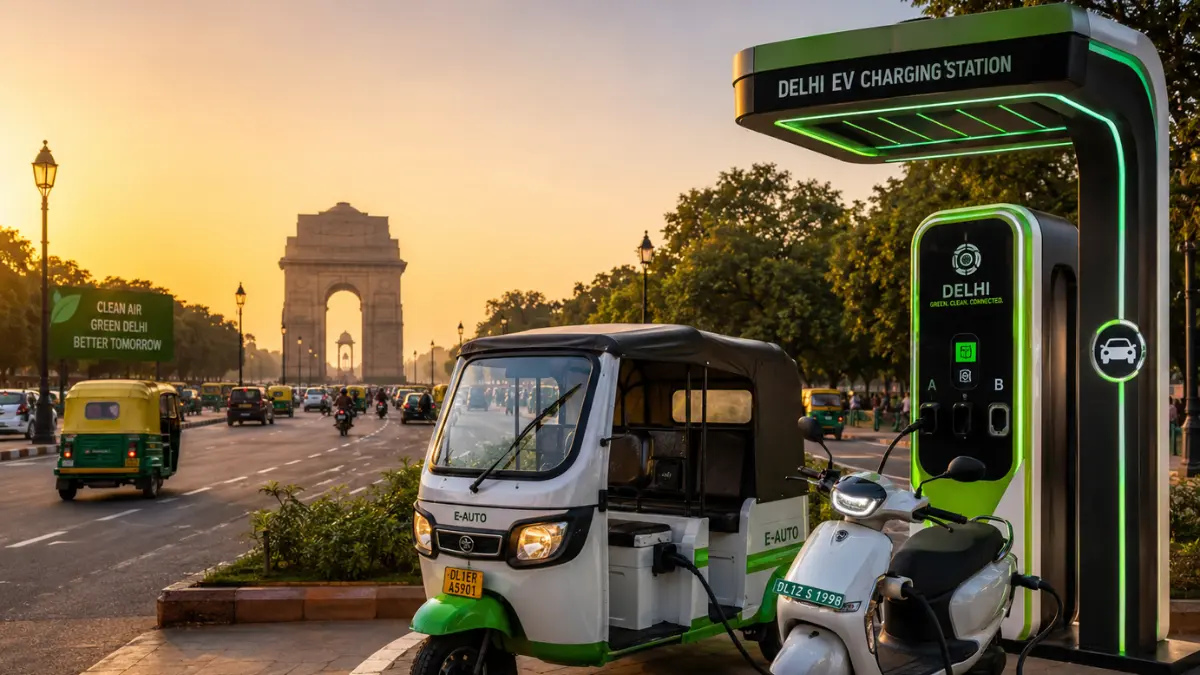
It sounds like a distant dream for a city famously battling air quality issues, but the Delhi Government has just shifted gears to make it a reality. With the official rollout of the Delhi EV Policy 2.0, effective today, the capital is launching a massive ₹15,000 crore initiative over the next four years.
The goal? To ensure that a staggering 95% of all new vehicles registered in Delhi are fully electric by 2027.
Industry leaders are already calling it a game-changer. Here is a deep dive into what the new policy means for commuters, businesses, and the future of Delhi’s air.
Delhi EV Policy 2.0 Blueprint: Strict Deadlines for a Cleaner Tomorrow
The government isn’t just hoping people will buy electric vehicles; they are drawing a hard line in the sand. To meet the aggressive 2027 target, the policy lays out a strict phase-out schedule for traditional internal combustion engine (ICE) vehicles:
- The Auto-Rickshaw Shift: Starting January 1, 2027, the only new auto-rickshaws allowed to register in Delhi will be electric.
- The Two-Wheeler Transition: By April 1, 2028, the registration of all new petrol-powered two-wheelers will be completely halted, limiting the market exclusively to electric models.
Show Me the Money: Subsidies and Scrappage
Transitioning millions of commuters to electric vehicles requires making them affordable. To ease the financial burden on buyers, the first year of Policy 2.0 introduces heavy direct-to-consumer incentives:
- Two-Wheelers: Buyers will receive a ₹30,000 subsidy.
- Three-Wheelers: Buyers get a ₹50,000 subsidy.
- Four-Wheelers: While there isn’t a direct purchase subsidy for electric cars, owners who scrap their old BS-IV vehicles to upgrade to an EV will receive a generous ₹1 lakh scrappage incentive.
Interestingly, the final policy gave the cold shoulder to hybrid vehicles. Despite earlier drafts suggesting a 50% road tax waiver for hybrids under ₹30 lakh, the finalized Policy 2.0 offers zero tax benefits or subsidies for them, making it clear that Delhi is placing all its bets on pure electric mobility.
The Industry Verdict: Optimism Meets Reality
The private sector has welcomed the policy with open arms, though experts warn that the road ahead isn’t without its potholes.
The Infrastructure Hurdle
Banning petrol two-wheelers by 2028 is a monumental step for air quality, but Akshit Bansal, Founder and CEO of Statiq, points out that the real test will be the power grid. Delhi currently has around 10,000 charging stations, but demand is skyrocketing. If the entire fleet goes electric, it could add up to 5,000 MW of load to the grid during peak hours. However, with ₹1,000 crore specifically earmarked for charging infrastructure, Bansal believes the government is showing serious intent to solve this.
The Affordability Question
For millions of Delhi residents, a petrol scooter is the only affordable way to get to work. Suyash Gupta, Director General of the Indian Auto LPG Coalition, cautioned that an “EV-only” approach might price out lower-income families due to high upfront costs. He advocates for a mixed approach, suggesting that clean, retrofitted Auto LPG vehicles should serve as a bridge while EV prices naturally come down.
The Investor’s Dream
Perhaps the biggest win of Policy 2.0 is the clarity it provides. Vasudha Madhavan, Founder and CEO of Ostara Advisors, noted that the real magic isn’t just in the subsidy amounts, but in the long-term certainty. Knowing exactly where the government stands through 2030 allows fleet operators, charging companies, and vehicle manufacturers to pour millions into the Delhi market with absolute confidence.
Beyond Commuters: Schools Lead by Example
The green wave isn’t stopping at private vehicles. In a parallel move under the EV Policy framework, Delhi is overhauling its school transport system. By 2030, 30% of all school buses in the capital must be electric.
Schools are on a tight timeline, required to transition 10% of their fleets within the next two years. Principals across the city have noted that while the transition will require heavy coordination with transport contractors, the phased approach gives them enough time to make the switch without disrupting student commutes.
The Road Ahead
Delhi’s EV Policy 2.0 is arguably one of the most aggressive and well-funded clean mobility blueprints in the world. The money is there, the deadlines are set, and the industry is on board. Now, the capital faces the ultimate test of execution: building the chargers, upgrading the power grids, and convincing the public to plug into the future.