
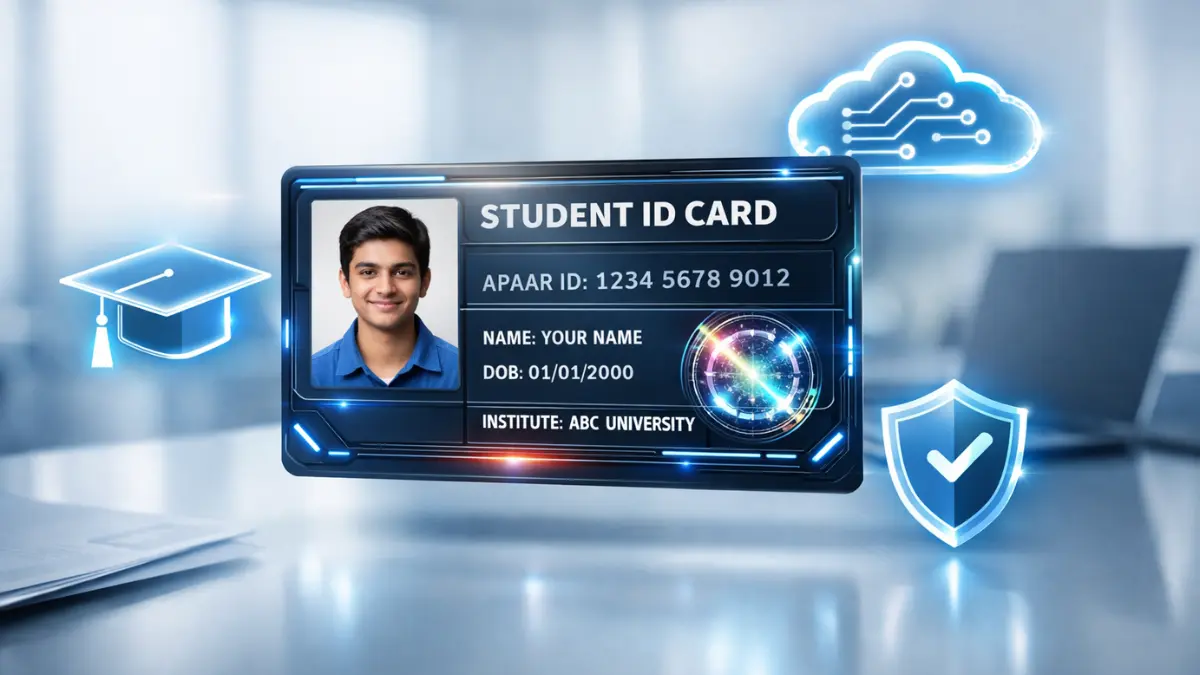
APAAR ID:In an era where our lives are increasingly digital, the Indian education system is taking a massive leap forward. Imagine a world where you never have to worry about losing a mark sheet, carrying a bulky folder for college admissions, or proving your extracurricular achievements from five years ago.
That world is here, and it’s called APAAR.
What exactly is an APAAR ID?
The Automated Permanent Academic Account Registry (APAAR), often dubbed the “One Nation, One Student ID,” is a specialized 12-digit identification number issued by the Ministry of Education.
Think of it as a digital resume that lives on the blockchain. It doesn’t just store your grades; it tracks your entire journey—from the day you enter pre-primary school to the moment you finish your PhD. It is linked directly to the Academic Bank of Credits (ABC), acting as a digital locker for your hard-earned “academic wealth.”
The Step-by-Step Roadmap: How to apply for APAAR ID online
Registering for your APAAR ID is surprisingly straightforward. Whether you are a student or a parent registering for a minor, here is how you get it done:
APAAR ID registration process 2026
Step 1: The Gateway (ABC Portal or DigiLocker)
Most students find it easiest to use the Academic Bank of Credits (ABC) portal.
- Visit [suspicious link removed] and click on “My Account” then “Student.”
- If you already have a DigiLocker account, sign in. If not, you’ll need to create one using your Aadhaar-linked mobile number.
Step 2: Authenticate with Aadhaar
Since the APAAR ID is linked to your Aadhaar for security, you will receive an OTP on your registered mobile number. This ensures that your academic records stay tied to you and no one else.
Step 3: Academic Mapping
You will be asked to select your current educational institution (School, College, or University), the year you joined, and your specific course.
Step 4: Generation and Download
Once you hit “Submit,” the system generates your 12-digit ID instantly. You can download a digital version of the card directly from the “Issued Documents” section in DigiLocker.
Why Should You Care? (The “High-Value” Benefits)
You might wonder, “Do I really need another ID number?” The answer is a resounding yes. Here is why this is a game-changer for the modern student:
- Seamless Mobility: Moving from a school in Delhi to a college in Bangalore? You no longer need to wait weeks for physical transfer certificates. Your new institution can access your verified records instantly via your ID.
- The “Credit” Advantage: If you take an online course on SWAYAM or a vocational skill class, those credits are automatically added to your APAAR profile. They don’t just “disappear”—they count toward your final degree.
- Scholarships Without the Stress: Applying for government scholarships usually requires a mountain of paperwork. With APAAR, the government can verify your eligibility and academic standing automatically, speeding up fund disbursements.
- Anti-Fraud Security: Fake degrees and forged certificates have long been a headache for employers. The APAAR ID provides a “Blue Tick” of sorts for your education, making you a more credible candidate in the job market.
A Quick Glance: APAAR vs. Traditional Records
| Feature | Old System | APAAR ID System |
| Storage | Physical Folders/Files | Secure Digital Cloud |
| Verification | Manual (Takes weeks) | Instant & Digital |
| Portability | Hard to move across states | Universal (One Nation) |
| Data Loss | High risk of damage/loss | Permanent & Lifelong |
The Human Touch: A Note on Privacy
It’s natural to feel a bit hesitant about “another digital ID.” However, the government has built APAAR with privacy-first protocols. Your data is only shared with educational institutions when you provide consent. For students under 18, parents have full control over the registration process, ensuring that the child’s data is protected from the start.
The APAAR ID isn’t just a bureaucratic requirement—it’s a tool of empowerment. It puts the “ownership” of education back into the hands of the student.