
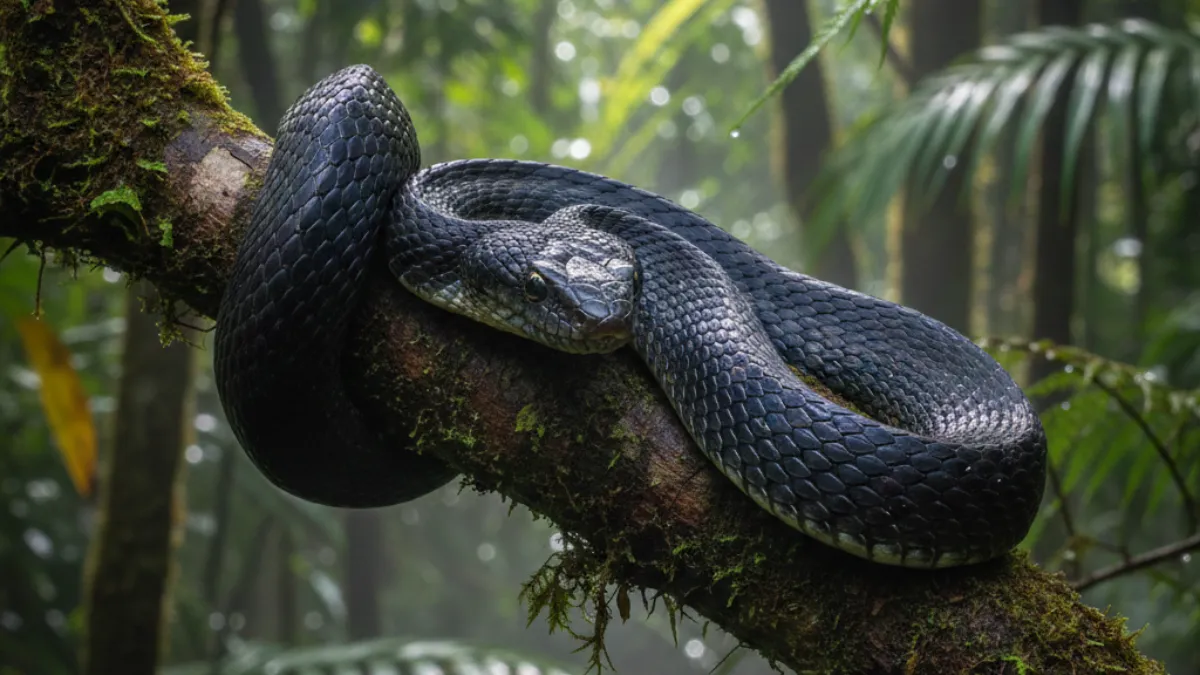
One of the greatest scientific discoveries has been made in the remote islands of Papua New Guinea, where researchers have made a discovery of an already unknown species of black snake within and surrounding an abandoned mine. The discovery has attracted the attention of the whole world, which shows the extent to which the biodiversity of the earth remains undiscovered.
The newly-identified species has been named Dendrelaphis atra, usually known as the black tree snake. Scientists indicate that the finding is rare as well as meaningful in the study of evolution of wildlife in island ecosystems.
Where the Discovery Was Made
The snake was discovered in Misima Island in Milne Bay Province of Papua New Guinea. This island is a constituent of the Louisiade Archipelago, which is a biodiversity-rich area that is poorly studied.
Interestingly the first appearance of the species was in an old gold mining area, which has demonstrated that even the most disrupted or deserted industries can have their own wildlife.
Later scientists verified the presence of the snake in:
- Forest edges
- Village garden areas
- Recycling mining land
This demonstrates that the species have adjusted to the natural environments and those that have been altered by humans.
Distinctive Body Anatomy of Black Snake
The most interesting thing about Dendrelaphis atra is its vivid looks and color change during the development stage.
Major features are:
- The body of the adult snakes is deep matte black.
- Dark, reflective eyes
- Length of nearly four feet
- A thin, hamstringed body that climbs on trees.
Scientists also noted that the snakes with younger ages are not entirely black. Juveniles are grey or brown and become darker with age- a trait that can hardly be observed in other species of snakes.
The word atra is Latin that literally translates as black, which is exactly its ultimate adult colour.
Scientific Investigation and Discovery
This species was first described by a famous herpetologist Dr. Fred Kraus of the University of Michigan. Researchers after long field surveys, advanced physical investigations, and comparison with the known species verified that the snake was a representative of the genus Dendrelaphis but was genetically and structurally distinct.
This scientific account was subsequently described in the international zoological journal Zootaxa which formally acknowledged the snake as a novel species.
A Rich Region with Life to be Discovered
Papua New Guinea can be considered one of the greatest biodiversity hotspots in the world. It contains a very high number of plant and animal species yet covers a very little area of the landmass of the earth.
According to the estimations of the scientists, approximately 5 percent of the total biodiversity in the world could be found in the country.
In the same research mission, other scientists also discovered three more new species of snakes on the adjacent islands, which served as further evidence that the area of the Milne Bay is one of the least studied by contemporary science.
The Significance of This Discovery
Further environmental significance: The finding of Dendrelaphis atra has broader environmental significance:
- Even in mining and disturbed regions demonstrates concealed biodiversity.
- Enhances scientific knowledge of the evolution of islands.
- Encourages development of conservation plans of vulnerable ecosystems.
- Stresses the importance of biological surveys prior to land development.
According to experts each new species that is discovered reinforces the argument for conservation of the remote islands habitats against uncontrolled deforestation and mining proliferation.
Status and Future Research of Conservation
The species has not been assessed in the IUCN Red List yet as it has just recently been discovered. Researchers emphasize that there is still a necessity in research that will help identify:
- Population size
- Breeding behavior
- Diet and ecological role
- Potential threats from habitat loss
The additional research will be used to determine whether there should be conservation of this rare species.
A Thinking of Nature with the Unspoken Secret
The identification of the black tree snake is a strong indication that there are numerous species yet to be discovered even in far-flung tropical areas.
As scientists keep excavating the islands of Papua New Guinea, further finds can be expected, as they all further illuminate our knowledge of the natural world and justify the necessity to preserve it.