
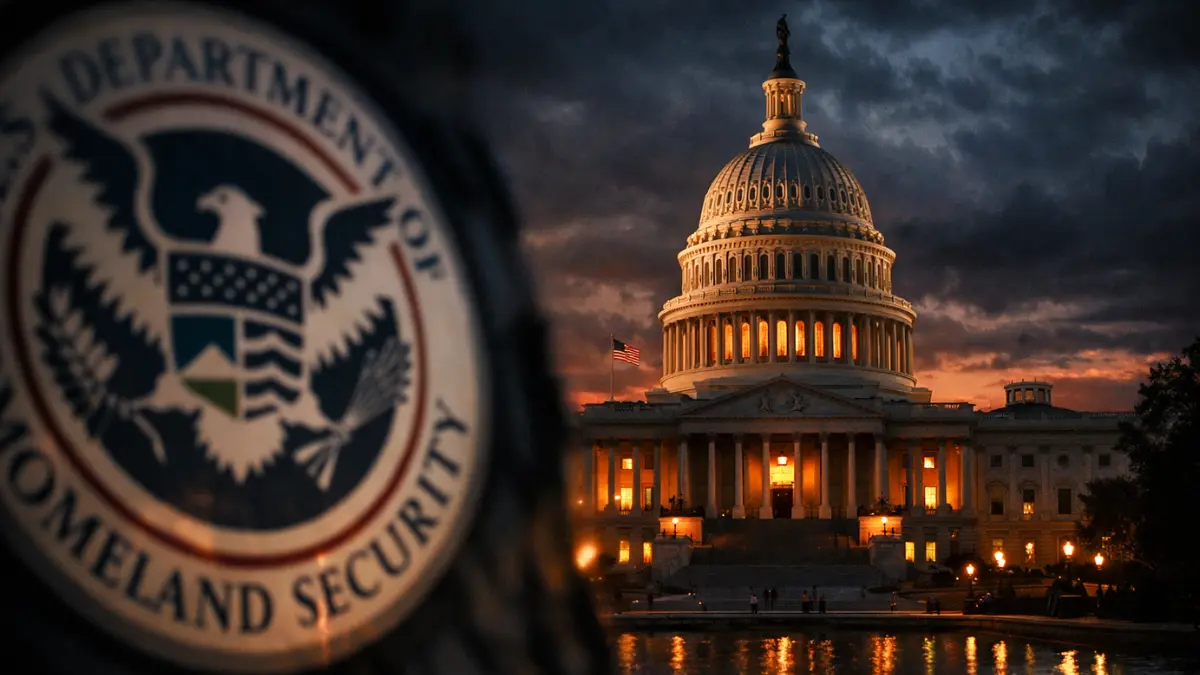
The Department of Homeland Security officially entered a partial shutdown this weekend, leaving thousands of essential workers without pay while political leaders in Washington remain deadlocked. It feels like a broken record, but this particular funding lapse is unique.
At a Glance: The Quick Breakdown
- What Happened: The Department of Homeland Security (DHS) entered a partial shutdown at midnight over a political standoff regarding immigration enforcement.
- The Catch: The agencies Democrats are trying to restrict—like ICE and CBP—are fully funded through previous legislation and will keep running.
- The Victims: Roughly 61,000 TSA workers, Coast Guard members, and FEMA disaster response teams are now forced to work without pay.
- The Outlook: Congress is on a 10-day holiday recess, meaning this standoff likely won’t end anytime soon.
It feels like a broken record in Washington, but here we are again. As the clock struck midnight on Saturday, the U.S. Department of Homeland Security (DHS) officially entered a partial shutdown. Lawmakers simply couldn’t reach an agreement on how to fund the sprawling department, leading to a massive political freeze.
But if you look under the hood of this specific shutdown, things get a little complicated—and highly ironic. The political fight triggering this crisis is entirely about reigning in federal immigration agents. Yet, due to a quirk in government funding, those exact agents are the ones who will keep getting paid, while airport security screeners and disaster relief workers are left holding the bag.
Here is a look at what’s actually happening behind the scenes, and how it might impact you.
The Heart of the Issue: The Battle Over ICE
To understand how we got here, you have to look back at January. A federal immigration raid in Minneapolis went tragically wrong, resulting in the fatal shootings of two U.S. citizens, Alex Pretti and Renée Good. The incident sparked national outrage and intensified demands for immediate law enforcement reform.
In response, Democratic leadership—spearheaded by House Minority Leader Hakeem Jeffries and Senate Majority Leader Chuck Schumer—drew a line in the sand. They refused to pass any new funding for the DHS unless it included strict, sweeping operational changes for Immigration and Customs Enforcement (ICE).
Their core demands included:
- No More Warrantless Entries: Agents would be strictly prohibited from entering private property without a judge’s signature.
- Full Transparency: A total ban on federal agents wearing face masks, along with mandatory visible badge numbers.
- Always-On Body Cameras: Immediate activation of body-worn cameras during all field operations.
- Anti-Profiling Measures: New, aggressive standards to eliminate racial profiling.
Republicans firmly rejected these demands, calling them a dangerous overreach that would hamstring law enforcement and put agents at risk. The result? A complete legislative deadlock.
The Irony: The Targeted Agency Survives
Here is the twist that has frustrated the lawmakers who pushed for the shutdown: ICE isn’t actually running out of money.
Last year, Congress passed a massive $170 billion funding package (often referred to by the White House as the “One Big Beautiful Bill”). Tucked inside that legislation was a massive $75 billion cushion specifically earmarked for ICE and Customs and Border Protection (CBP).
Because of this pre-existing war chest, ICE and border agents can continue their operations completely uninterrupted through the end of the fiscal year. Senator John Fetterman (D-PA), the only Democrat to vote with Republicans in a last-ditch effort to keep the government open, pointed out the painful reality: “This shutdown has literally zero impact on ICE.”
The Real Human Impact: TSA, FEMA, and Your Travel Plans
So, if ICE is fully funded, who is actually suffering? The answer lies with the hundreds of thousands of everyday federal workers who keep the country moving.
Because they rely on the annual budget that just lapsed, vital agencies are now thrust into financial chaos:
- Your Airport Commute: Roughly 61,000 TSA screeners are deemed “essential,” meaning they still have to show up to the airport to check your bags and screen your shoes—but they won’t get a paycheck. Historically, when this happens, many workers are forced to call out sick to find side jobs to feed their families, leading to massive security lines.
- Disaster Relief: FEMA’s direct emergency relief fund has about two months of cash left, but their ability to reimburse state governments for ongoing rebuilding efforts is completely frozen.
- The Coast Guard: Active-duty members guarding our waterways are now working for free.
What Are Voters Saying?
The American public seems deeply divided on the issue, reflecting the polarized state of the capital.
According to a recent Hart Research poll, there is genuine public appetite for police reform: 54% of likely voters actually support holding up DHS funding until ICE changes its operational tactics, and 60% view the agency unfavorably.
However, the White House is betting that the public’s patience will wear thin. They have aggressively branded this a “Democrat-driven shutdown,” arguing that the opposition is holding vital services—like airport security and disaster relief—hostage for an ideological agenda.
What Happens Next?
If you were hoping for a quick resolution, you might want to temper your expectations.
Congress has already packed its bags and left town for a 10-day recess to observe the President’s Day holiday. The halls of the Capitol are quiet. While Senate Majority Leader John Thune has promised that he can recall lawmakers to Washington within 24 hours if a breakthrough occurs, no backroom deals seem imminent.