




January 22, 2026
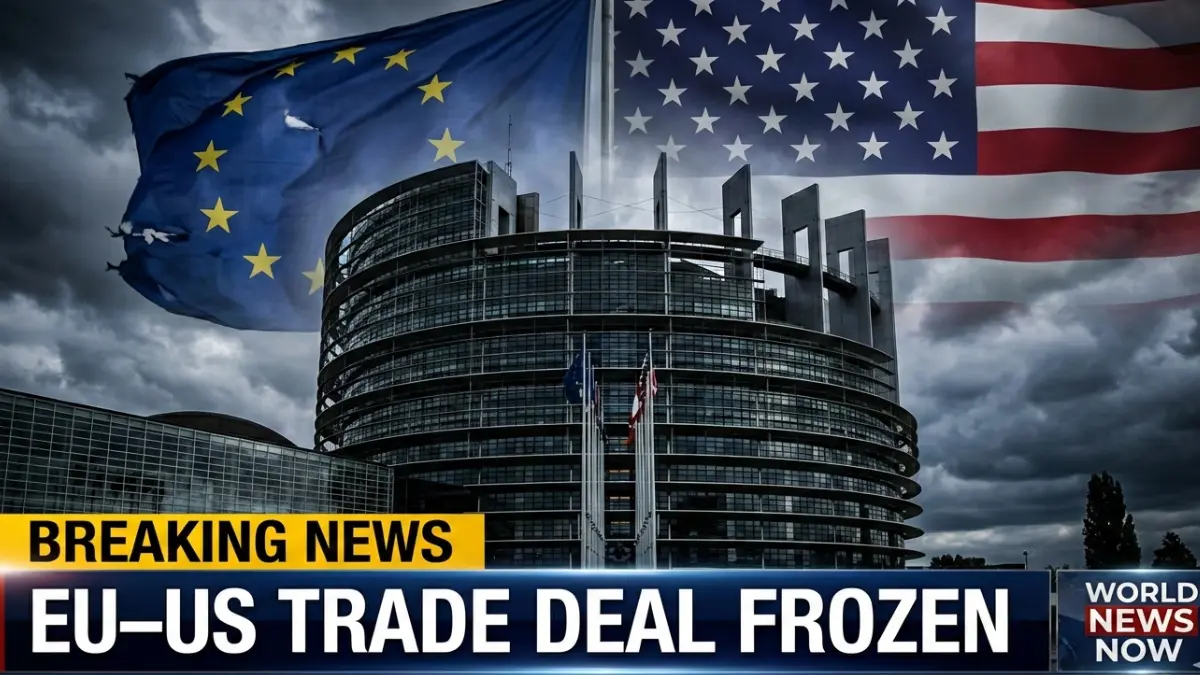
The EU US trade deal freeze has sent shockwaves across global markets after the European Parliament officially suspended the approval process of a major transatlantic agreement. The move follows growing diplomatic tensions triggered by former US President Donald Trump’s renewed remarks on Greenland and fresh tariff threats aimed at European nations.
According to European lawmakers, the ruling sends a very strong message, which is that trade partnerships cannot be maintained when there is political pressure or economic bullying.
Why the EU US Trade Deal Grounded
This trade accord that was signed last year after several months of discussions was intended to normalise economic relations between the European Union and the United States at a time of unpredictability in the global context.
Nevertheless, the freeze of the EU US trade deal was declared following the decision of lawmakers who found no more sense in the fair cooperation because of the existing political environment.
The European Parliament members emphasized that until the threats become a part of the diplomatic process, the approval can not be continued.
Greenland Statements by Trump Elicit a Backlash
The situation worsened when Donald Trump in his speech at the World Economic Forum in Davos rekindled the concept of US talks over Greenland, an autonomous territory of Denmark.
Vetoing military action, Trump threatened to impose new trade tariffs on European nations that have not cooperated with the US interests revitalizing the risk of an economic confrontation.
European leaders termed the statements as unacceptable and unfit against international standards.
EU Parliament Sends Serious Political Messages
Bernd Lange, the head of the International Trade Committee in the Parliament, claimed that the EU-US trade agreement freeze was to save the economic autonomy of Europe.
He said that trade agreements should be founded on trust and not threats.
Cross-party lawmakers defended the freeze in the name of a defence of European sovereignty and democratic decision-making.
The contents of the Trade Agreement.
The deal intended to:
- Minimize tariffs between EU and US industry.
- Enhance accessibility to markets by manufacturers.
- Enhance the collaboration along supply chains.
- Normalise transatlantic trade relations.
Nevertheless, despite these intentions, critics claimed that the agreement did not eliminate all US tariffs on European exports, and this could be an issue of imbalance.
The Importance of Greenland to the Controversy
The activities in Greenland have turned it into a geopolitical hotspot because of:
- The strategic Arctic shipping lines.
- Availability of rare earth minerals.
- Security interests and long-term military interests.
European officials think that the territorial pressure, even verbal, can pose a threat to the stability of the regions and compromise the diplomatic trust.
Economic Implication of EU US trade deal freeze
In case of tension, the European Union can look at:
- Its Anti-Coercion trade mechanism was switched on.
- Introduction of retaliatory billions of euros tariffs.
- Stalling prospective trade collaboration negotiations.
Analysts are concerned that long term disruption would impact on automobile, technology, energy and agricultural industries.
What Happens Next?
EU leaders are supposed to hold emergency consultations in Brussels. The trade agreement will be frozen until:
- Threats of tariff are dropped.
- Political sanity is revived.
- Respect among partners is restored once again.
To date, the freeze of the EU US trade deal can be seen as one of the most powerful diplomatic messages sent by Europe in decades.
Bigger Picture: More Than a Trade Dispute
This is not one of those decisions that are entirely economic. The freeze is indicative of the wider European attitude towards coercive diplomacy and its adherence to global trade conducted on the basis of rules.
The results of this confrontation may change the further development of the relations between the EU and the US as the global power dynamics change.