
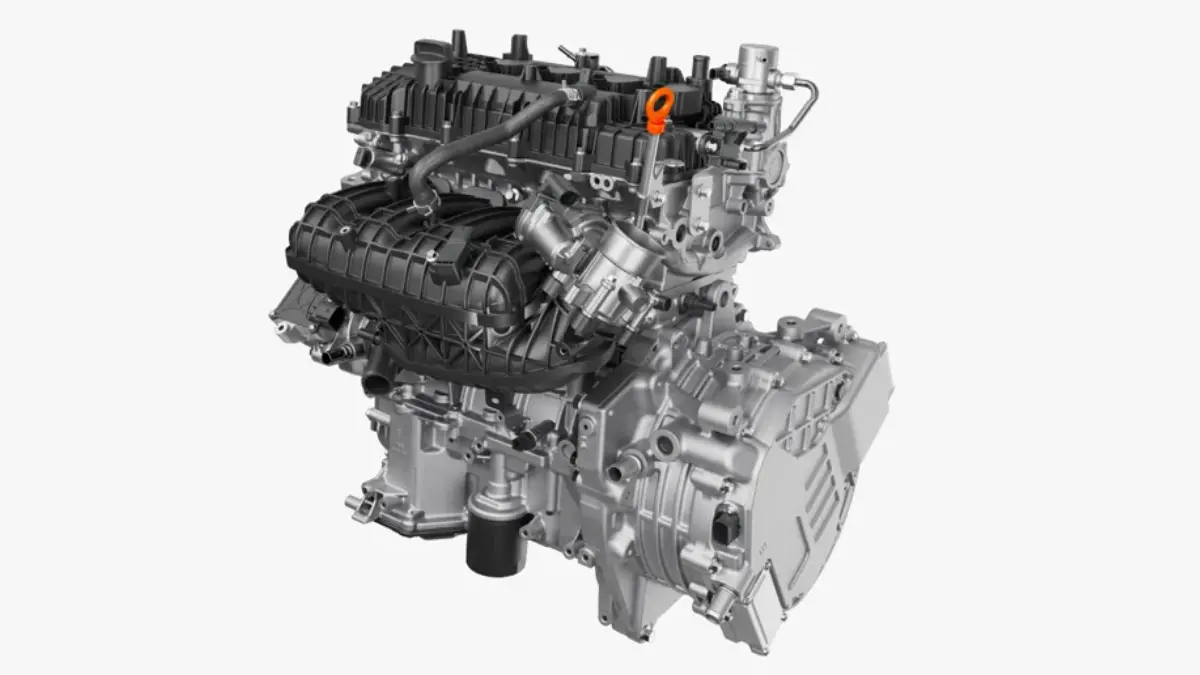
Engine; Let’s be honest, even the most die-hard electric vehicle enthusiasts have experienced that creeping sensation of range anxiety. You’re on a long highway stretch, the battery percentage is dropping faster than expected, and the next fast charger is nowhere to be found. Haven’t you ever wished you could just pull over and pour a gallon of petrol into your EV to get home?
Well, the automotive aftermarket has been listening. A company called Horse Powertrain just dropped a bombshell on the industry with a radical new unit that allows you to convert a fully electric car into a gasoline-hybrid.
Yes, you read that right. We are officially reverse-engineering EVs. Here is everything you need to know about the breakthrough Horse X-Range C15 Direct Drive.
The “Pancake” Approach: How Does It Actually Fit?
If you know your way around cars, your first question is probably about space. Modern EVs are built on “skateboard” platforms. The floor is packed entirely with batteries, leaving zero room for a traditional, upright internal combustion engine (ICE) under the hood.
Also Read: New Benchmark: 2027 BMW 7 Series Embraces a Radical Digital Future
Horse Powertrain cracked this packaging nightmare by looking backward to move forward. Taking inspiration from the flat-packaged, mid-engine designs of the 90s (think of the legendary Toyota Previa), they designed the system to lie completely flat.
The X-Range setup is a two-part harmony:
- The C15 1.5-liter four-cylinder engine acts as your gas-powered range extender.
- The F15 electric motor handles the heavy lifting for main propulsion.
Because the 1.5-liter engine is “pancaked,” the entire hybrid unit slots perfectly into the tight subframe space usually occupied by a standard EV drive motor. In fact, the control electronics actually take up more vertical space than the engine itself! It comes out of the box as an all-in-one package, available in either a 94-horsepower naturally aspirated version or a punchy 148-horsepower turbocharged variant.
Why Automakers Are Paying Close Attention
While swapping a gas engine into a battery-electric chassis sounds like a wild weekend garage project, the real genius of the X-Range C15 is its commercial potential.
Global EV adoption is facing a reality check. While city drivers love their BEVs, buyers who frequently tackle long cross-country routes—especially in vast markets like India where highway charging infrastructure is still playing catch-up—are pivoting back toward Plug-in Hybrid Electric Vehicles (PHEVs).
Instead of spending billions of dollars developing entirely new hybrid chassis from scratch, automakers can use this drop-in powertrain. It allows them to quickly offer hybrid variants of their existing EV lineups on the exact same manufacturing platform. It’s a massive shortcut that saves time, money, and R&D headaches.
The Reality Check: Is It a Simple Swap?
Before you rip the electric motor out of your current daily driver, let’s temper expectations. While the packaging is brilliant, the laws of physics still apply. Converting an EV to a hybrid is not exactly plug-and-play.
If you attempt this retrofit, you still have to figure out a few massive logistical hurdles:
- Fuel Storage: Where are you safely mounting a petrol tank in a chassis never designed to hold combustible fluids?
- Thermal Management: Gas engines generate immense heat. You’ll need to route custom plumbing to a newly fabricated front radiator.
- The Software Shake-up: Modern cars are essentially computers on wheels. Getting a new gas engine to talk flawlessly with an EV’s native control modules requires some serious custom tuning.
The Verdict
The Horse X-Range C15 is a fascinating piece of automotive rebellion. For the everyday consumer, it’s going to require a masterclass in custom fabrication to get it running. But for the broader industry, it is a brilliant stop-gap solution. It physically bridges the gap between the internal combustion cars of our past and the electric platforms of our future.
What do you think of this wild engineering twist? Would you ever consider turning your EV into a gas-guzzling hybrid, or is the future strictly battery-powered?