
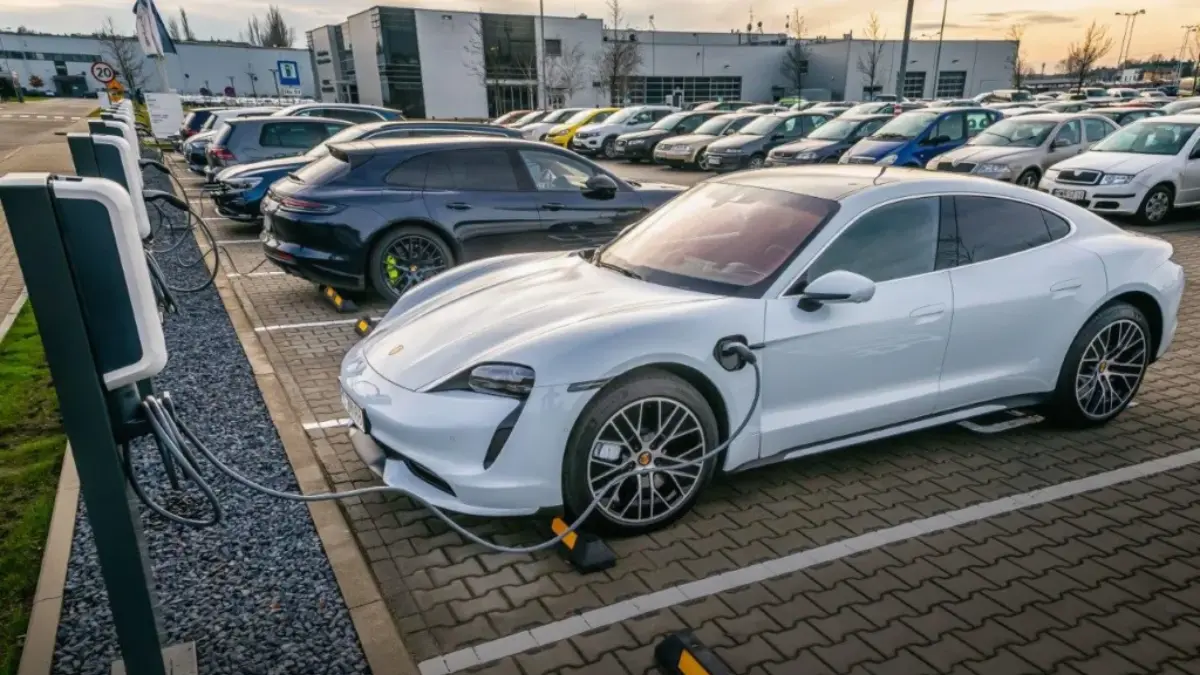
Pl: Walking through a car dealership in Norway today feels like stepping into a time machine set ten years into the future. The roar of the engine and the smell of diesel fumes are becoming echoes of a bygone era. According to the latest data released this week, Norway has just shattered its own records, proving that the transition to a zero-emission future isn’t just “underway”—it’s essentially complete.
In April 2026, electric vehicles (EVs) captured a mind-blowing 98.6% of the new car market. To put that in perspective, out of every 1,000 cars sold, only 14 had an exhaust pipe.
Pl Death of the Fossil Fuel Dream
For decades, the rumble of a diesel engine was a symbol of reliability in the rugged Norwegian landscape. No more. The latest figures from the Road Traffic Information Council (OFV) show a market in the midst of a total “electric takeover.”
In April, only 87 new diesel cars were sold in the entire country. Gasoline performed even worse, with a mere 31 units finding buyers. For the second month in a row, Norway has hit a historic peak, signaling that the internal combustion engine has been relegated to a niche curiosity for collectors and enthusiasts.
From the Fjords to the High North: A National Shift
What makes this record particularly impressive is its geographic uniformity. Critics once argued that EVs were only practical for city dwellers in Oslo. April’s data effectively silences that argument.
Every single county in Norway reported an EV market share above 95%. Even in Finnmark, deep within the Arctic Circle where winters are brutal and distances are vast, 95.1% of new car buyers chose electric. Meanwhile, in Østfold, the transition is virtually absolute, with EVs claiming 99.3% of the market.
A New Hierarchy: Volkswagen Takes the Lead
While the headlines often focus on Tesla, April told a different story of brand competition. While Elon Musk’s Tesla remains the year-to-date king, it slipped to 11th place in April registrations.
Taking the throne for the month was Volkswagen, led by the continued popularity of the ID.4. Toyota and BMW followed closely behind, proving that traditional automotive giants have successfully pivoted their engineering and marketing to meet the demands of a country that simply refuses to buy gas anymore.
The “Second Life” of Electric Cars
Perhaps the most significant shift isn’t happening in the shiny showrooms, but on the used car lots. For years, the second-hand market remained the last stronghold for diesel engines.
That wall has finally crumbled. For the first time in history, electric cars are now the most traded vehicles in the used market, accounting for 35.9% of all ownership changes. This suggests that the “fear of the unknown” regarding battery life and charging has evaporated, and EVs are now seen as a safe, long-term investment by the average Norwegian family.
Last Frontier: Vans and Commercial Hauling
While passenger cars have crossed the finish line, the “Green Revolution” still has work to do in the commercial sector. New van registrations actually grew by 18% in April, but the electric share for these workhorses sits at 55.8%.
Also Read: Kia Gears Up for Hybrid & EV Expansion in India: Sorento, Carnival Hybrid and Syros EV on the Way
For plumbers, carpenters, and delivery drivers, the transition is slower due to the need for higher towing capacities and longer ranges under heavy loads. Experts suggest that as battery technology improves for heavy-duty vehicles, this will be the final domino to fall.
A Lesson for the World
Norway’s milestone is more than just a local statistic; it is a proof of concept for the rest of the planet. Through a combination of smart tax policy, heavy investment in charging infrastructure, and a public that has embraced change, Norway has shown that the “impossible” transition to green transport is not only possible—it’s inevitable.
The roar of the engine is fading, replaced by the quiet hum of a country driving toward a cleaner tomorrow.