
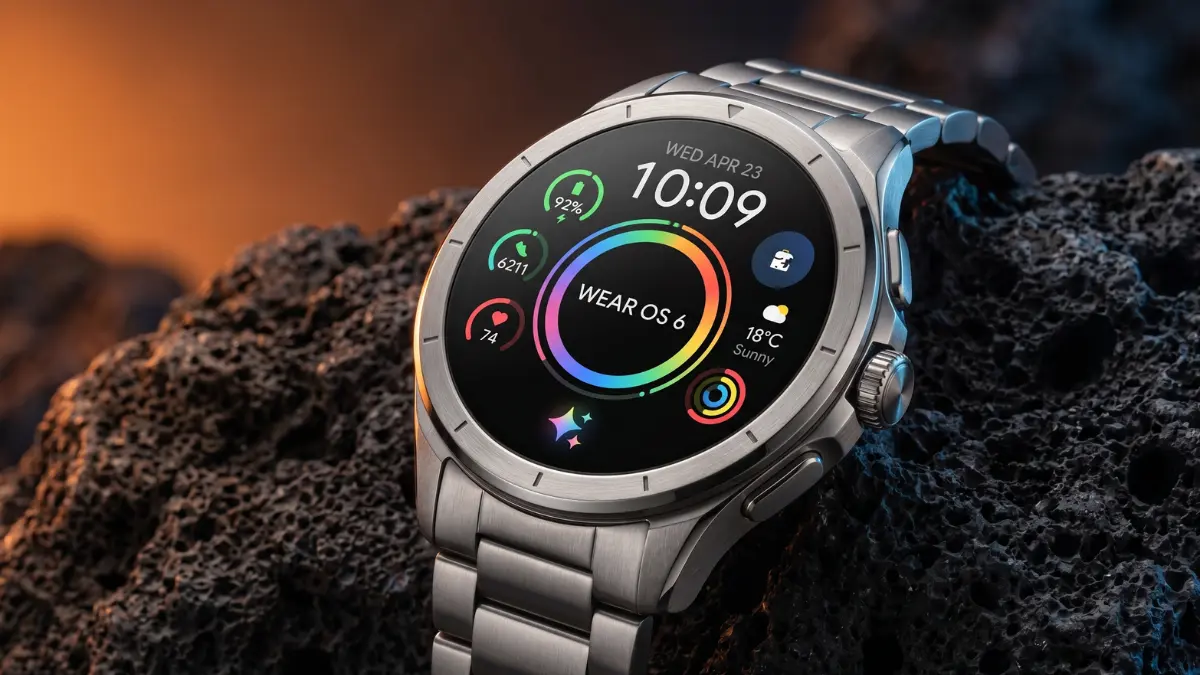
OnePlus Watch 4: The premium smartwatch landscape just got a lot more interesting. Without the usual hype of a “Launch Event,” OnePlus has quietly updated its official product pages with the OnePlus Watch 4. It’s a device that feels like a masterclass in industrial design, yet it carries a processor choice that has tech enthusiasts scratching their heads.
Here is everything you need to know about the new titanium-clad flagship.
A Masterclass in Premium Build
The first thing you’ll notice is the shift toward high-end materials. Moving away from standard stainless steel, the OnePlus Watch 4 features a Titanium Alloy shell. The 47.4mm chassis comes in two sophisticated textures: Evergreen Titanium and Midnight Titanium.
Also Read: OnePlus Goes All-In on Battery: Nord CE 6 and CE 6 Lite Set for India Launch
Despite the rugged metal build, it remains surprisingly light at 43g. OnePlus hasn’t just focused on looks, though; this watch is built like a tank. It carries MIL-STD-810H military-grade certification and a new IP69 rating, meaning it can withstand high-pressure, high-temperature water jets—well beyond your average rainy day or swimming session.
The Display: Brighter Than Ever
The screen remains a 1.5-inch LTPO OLED panel with a sharp 466 × 466 resolution, protected by ultra-tough Sapphire Crystal. However, the real “pro” upgrade here is the brightness. In sports mode, the display can now peak at 3,000 nits. Whether you are hiking in the glaring desert sun or cycling at high altitudes, the screen remains as readable as a sheet of paper.
Software: The Wear OS 6 Pioneer
This is where the OnePlus Watch 4 truly shines. It is one of the first wearable devices to ship with Wear OS 6 (based on Android 16). This isn’t just a minor update; it brings Native Gemini Integration to your wrist.
Forget basic voice commands; Gemini allows for “context-aware” help. You can ask it to summarize long email threads, draft replies, or set complex reminders using natural language. The watch runs OxygenOS Watch 8 on top, which feels fluid, minimalist, and deeply integrated into the OnePlus ecosystem.
The Chipset Debate: If It Ain’t Broke?
If there is a “catch,” it’s under the hood. For the third year in a row, OnePlus is sticking with the Qualcomm Snapdragon W5 Gen 1 and the BES 2800 co-processor.
While the W5 is a highly efficient chip, the absence of the newer Snapdragon Wear Elite platform is notable. OnePlus seems to be betting that their “Dual-Engine Architecture”—which offloads simple tasks to the low-power BES chip—is more important for the user experience than having the newest raw processor on the market.
Battery Life: Still the Industry Gold Standard
The primary reason OnePlus likely stuck with the W5 chip is battery efficiency. The 646mAh battery continues to put the Apple Watch and Pixel Watch to shame:
- Smart Mode: Up to 100 hours (over 4 days) of full Wear OS functionality.
- Power Saver Mode: Up to 16 days while still tracking heart rate and sleep.
- Flash Charge: A quick 10-minute charge provides enough power for a full day, with a 0-100% top-up taking about 75 minutes.
Verdict: Should You Wait?
The OnePlus Watch 4 is an “evolutionary” jump rather than a total reinvention. If you value a titanium build, the latest Android software (Wear OS 6), and a battery that doesn’t require a nightly charge, this is arguably the best Android watch 2026.
However, if you were hoping for a brand-new processor to future-proof your tech for the next five years, the Snapdragon W5 might give you pause. We are still waiting for official global pricing, but expect it to sit comfortably in the $350 – $399 range.
Key Specifications at a Glance:
- Build: Titanium Alloy / Sapphire Glass
- Water Resistance: 5ATM / IP68 / IP69
- Software: OxygenOS Watch 8 (Wear OS 6)
- AI: Built-in Google Gemini
- Sensors: Heart Rate, SpO2, Wrist Temperature, Fall Detection
- Storage: 32GB ROM / 2GB RAM