
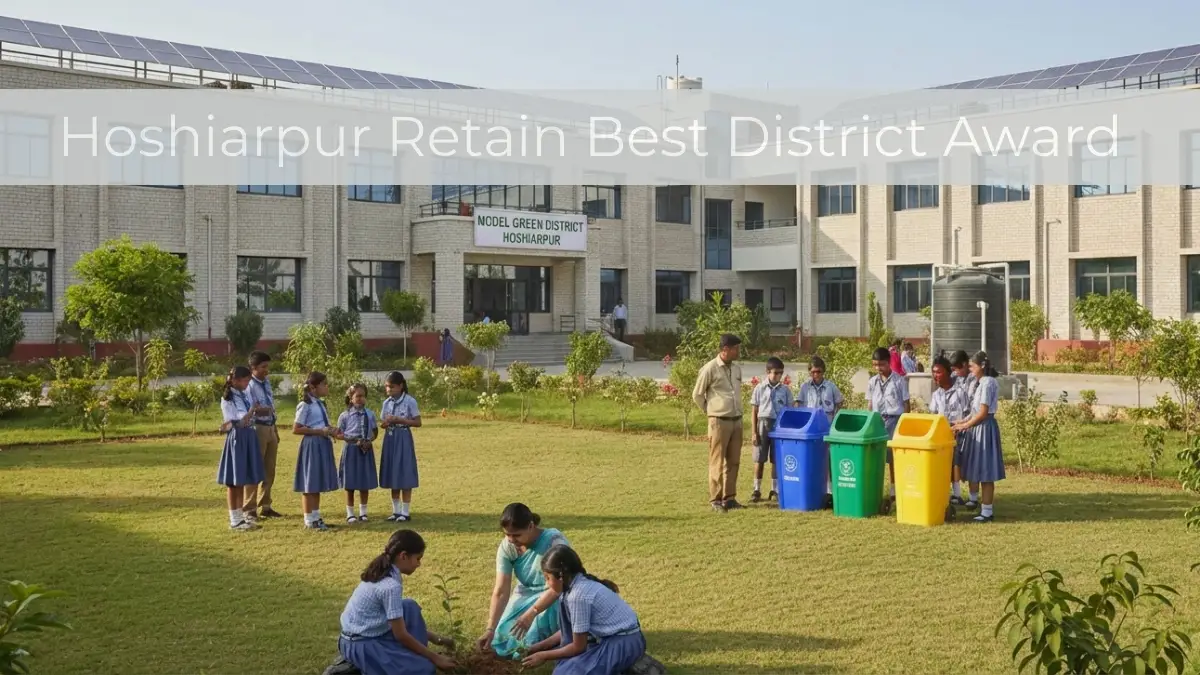
Hoshiarpur Retains Best District Title in National Sustainability Audit
Punjab has achieved a national standard in environmental education when it became a national winner in the third consecutive year in the Green School Programme (GSP) under the Best State Award. To top the success, Hoshiarpur district maintained its position of the Best District and once again Punjab led in terms of delivering sustainability using schools.
The awards were given as the Green School Programme 2025-26 audit, by the Centre of Science and Environment (CSE), a non-profit making organisation based in Delhi, which endeavours to promote environmental consciousness and action in India.
The Dominant Punjab in the Green School Programme
The state of Punjab had excelled in the country, in terms of participation and performance.
Among the 7,407 schools in 28 states and Union Territories participating in the audit, Punjab had submitted 6,264 of these reports, which is more than 84 percent of the total entries.
Quality performance was also in the lead of the state. Out of the 433 schools that received a green rating in the whole of India, a staggering 237 schools were in Punjab, which demonstrates the extent to which the environment practices were implemented in its schools.
Emerging As a Green District Model Hoshiarpur
Hoshiarpur maintained its streak when it won the Best District again.
The district had 947 school audit reports, the largest in the state, and thus it became a role model on how schools in the country can manage their environment and student involvement in environmental programs.
The leaders observed that the effectiveness of the district is due to consistent interactions between schools, educators, learners, and community education agencies.
Green School Audit Measures
Green School Programme assesses schools based on six major parameters of sustainability making sure that the environmental responsibility is holistic:
- Air quality and air pollution control.
- Energy efficiency
- Food practices and nutrition.
- Management of biodiversity and land.
- Water conservation
- Waste management
These indicators assist schools to know their environmental footprint and make realistic actions to minimize the same.
Key Findings from the 2025–26 Audit
The audit data showed positive tendencies in the schools that participated:
- Non-polluting transport options were used in 56 percent of the schools.
- 34% have changed to energy efficient lighting systems.
- Classroom ventilation is good at 73%.
- Over 31 percent of them practice rainwater harvesting.
These figures indicate that schools are increasingly being aware of their responsibility toward the climate and conservation of resources.
CSE The Highlight of Student Group Change
CSE Director General Sunita Narain has highlighted the role of students in sustaining activities. According to her, the Green School Programme allows students to quantify, comprehend, and enhance their consequences on the environment, and transform classrooms into genuine learning settings of the real world.
The officials of CSE are of the opinion that the practices practiced within the school settings tend to spread beyond the campuses to the families and communities, which build long-term environmental awareness.
Special Recognition Schools of Excellence
In addition to state and district awards, a number of schools were recognised as having an outstanding performance:
- Satya Bharti School, Ludhiana was one of the winners in the Changemaker Award in the Primary School category.
- The New English Medium School, Pune, Vidya Pratishthan was the one identified in the category of Secondary with notable progress in the sustainability practices.
It was also realized that long term commitment was recognized in schools that have had green ratings more than ten years.
Reason Behind This Success
The continued success of Punjab serves as an illustration on how education may lead to change of the environment where the students are actively engaged in the process of monitoring and enhancing sustainability practices. The Green School Programme does not only ensure environmentally friendly infrastructure, but also produces environmentally conscious citizens.
With the escalation of climate issues, the case of Punjab tells us that schools can become a key factor in creating a more responsible and greenish future of India.