


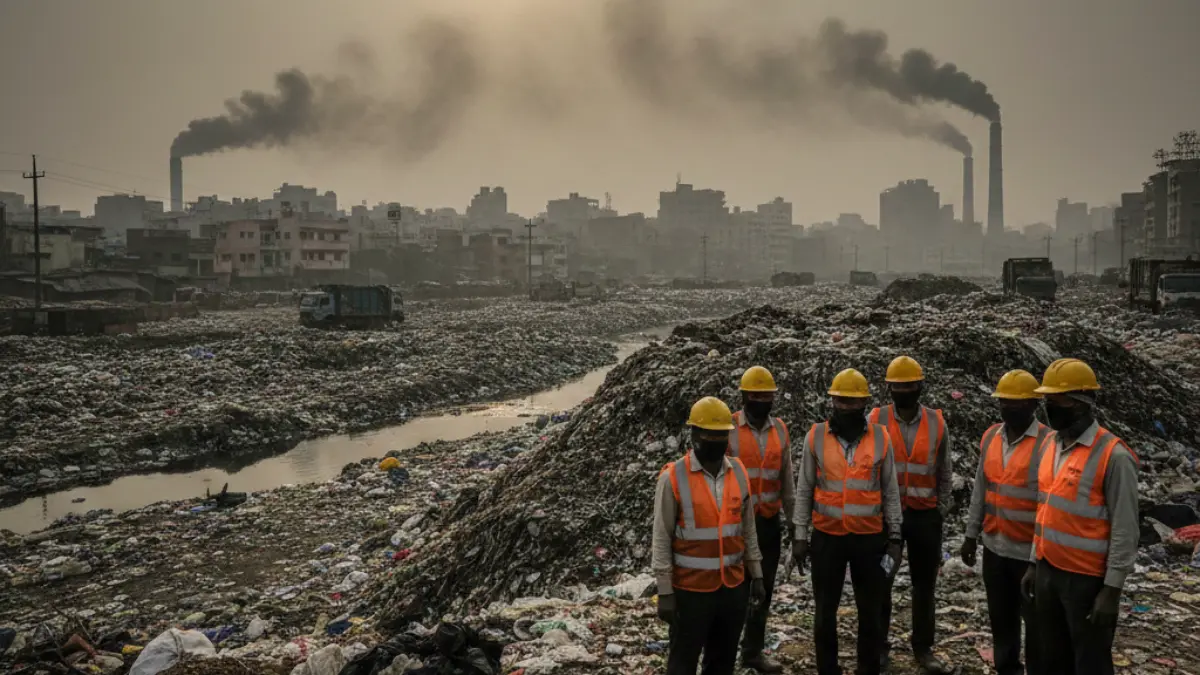


Punjab solid waste penalty has emerged as a major concern after an RTI revealed that municipal bodies across the state are paying nearly ₹10 lakh every day for failing to manage garbage scientifically, causing a financial and environmental crisis. The frightening data is revealed in a Right to Information (RTI) response, which reveals decades of administrative laxity.
The Punjab Pollution Control Board (PPCB) is imposing the penalties on the violation of the Solid Waste Management Rules, 2016, with strict instructions of the National Green Tribunal (NGT).
Massive Economic Conflagration of Municipal Organizations
In line with the RTI data, municipalities in Punjab have been paying hefty penalties after July 2020, when the NGT instructed the civic bodies to pay environmental compensation to those that were unable to scientifically process wastes or remove the garbage dumps left over in the past.
Penalties on average cost about 3 crore every month which translates to enormous burden to the already cash strapped municipal corporations and councils.
Environmental compensation to the urban local governments in Punjab has been staggering with a total of ₹170.12 crore to be paid between July 2020 and June 2025.
Why Are the Municipalities being Punished?
The fines are being implied because of the various violations such as:
- Lack of segregation of waste on site.
- Absence of scientific waste processing plant.
- The legacy waste dumps have not been remedied.
- Lack of endorsed solid waste management plans.
- Identical dumping of untreated garbage.
Most municipal bodies did not file working compliance plans by April 1, 2020, and were led to automatic penalties under NGT rules despite multiple warnings and deadlines.
Punishment System in National Green Tribunal
The NGT has pegged environmental compensation on the number of people:
- Cities having more than RS.10 lakh population: Rs.30,000 every month.
- The cities where the population is between Rs.5-10 lakh: Rs.5 lakh/month.
- Small towns and councils: Rs.1 lakh/month.
This is a systematic process that will ensure penalties are met every month until complete compliance has been reached.
Punjab Solid Waste Penalty Year-Wise Penalty Details
RTI response shows that the penalties have been increasing gradually over the years:
- ₹31.84 crore (July 2020 – March 2021)
- ₹35.26 crore (April 2021 – February 2022)
- ₹50.43 crore (March 2022 – September 2023)
- ₹14.76 crore (October 2023 – March 2024)
- ₹7.65 crore (April 2024 – June 2024)
- ₹15.12 crore (July 2024 – December 2024)
- ₹15.06 crore (January 2025 – June 2025)
The numbers indicate that even after paying crores in fines, improvements at ground levels are substantially low.
Big Cities in Defaulters
Municipal corporations in Punjab have developed into some of the largest defaulters:
- Ludhiana Municipal corporation: about 6cr.
- Amritsar Corporation: about 6 crores.
- Jalandhar Municipal Corporation: about 3 crore.
The cities produce hundreds of tonnes of garbage per day but do not have enough processing facilities to process the waste materials effectively.
The Money is Going Down The Drain, Public
Kamal Anand, an activist and advocate of RTI who demanded the information, highly criticised the authorities on its squandering of public money.
He indicated that rather than municipalities investing in modern waste processors, they are using the money of tax payers in day-to-day penalties which would not offer a permanent solution.
He said that citizens are paying twice, the first time in taxes and the second in environmental damage and health hazards.
Environmental and Health Issues on the Increase
Continued dumping of untreated wastes is life-threatening, and may include:
- Groundwater contamination
- Soapstone pollution of the air due to garbage fires.
- Transmission of infectious diseases.
- Rearing of rodents and mosquitoes.
- Long-term soil degradation
Some mountain-like legacy waste dumps, some of which run into millions of tonnes, are still present in several cities, very dangerously near residential areas.
PPCB Warns of Repeated Violations
The Punjab Pollution Control Board has made several notices to the Local Government Department in the state, and they have asked the department to correct the situation at hand.
Authorities have threatened that failure to comply can result in even more penalties, and further legal actions that are more strict can be enforced.
A Wake-Up Call on Urban Governance
The RTI exposures have reiterated that there have been some lapses in the urban system of governance in Punjab. As the punishments are ever increasing day by day, the good management of waste is still mostly on paper.
- Without, environmental experts think the environment will be worse off.
- Hard segregation enforcement.
- Public awareness campaigns
- Contemporary waste-to-energy and waste processing facilities.
- Responsibility of civic officers.
the crisis will only worsen.
And that Punjab municipalities are paying 10 lakh a day in fines is not only an economic concern, it is a bigger failure of planning, accountability and environmental responsibility.
The state can be in the danger of a prolonged ecological catastrophe in case some significant changes are not made as soon as possible, and citizens are the ones who will eventually end up being the victims.