
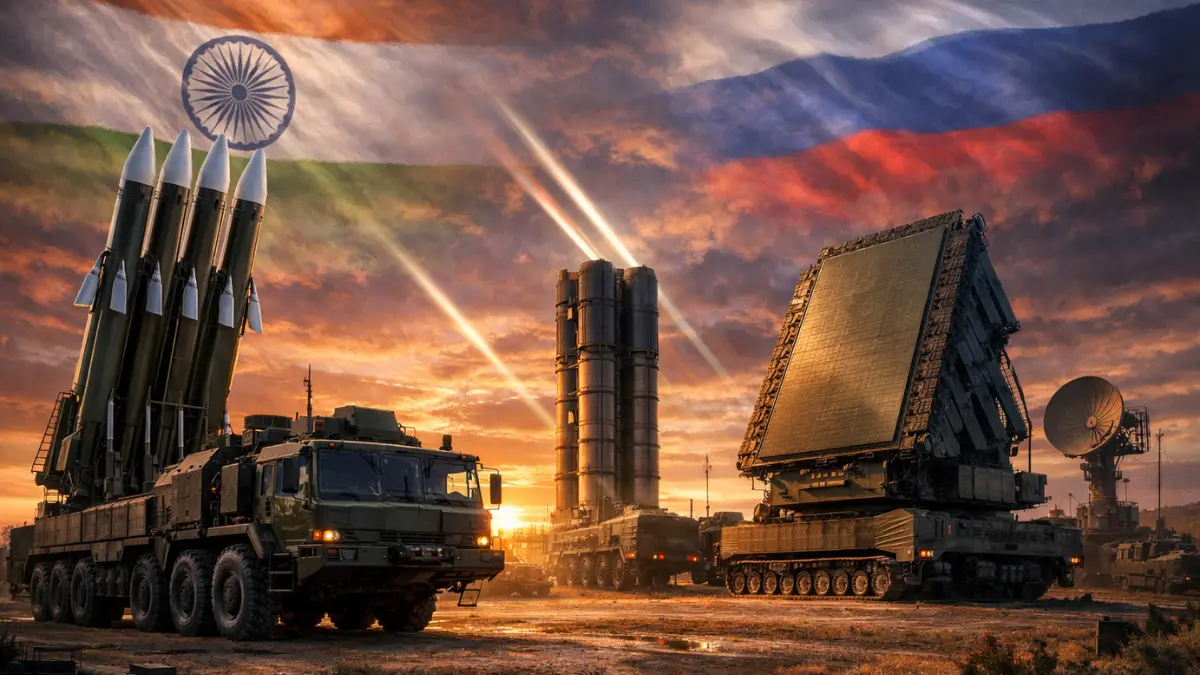
Russia has successfully built its first S-500 missile regiment of air and missile defence and then introduced it to active service, which has caused a new wave of strategic interest among India. Now that the system is officially in operation, Moscow has hinted in her quiet manner that India may be a prospective export customer in the future, as soon as the domestic needs of Russia are fulfilled and her production capacity is increased.
This comes when India is busy enhancing its multi-layered air and India missile defence system to intercept any emerging threats in the region such as hypersonic weapons and long range ballistic missiles.
S-500 Prometheus: One of the Greatest Breakthroughs in Air Defence
Another air and missile defence system that is viewed as one of the most sophisticated in the world is the S-500 Prometheus which was designed by a Russian state-owned defence corporation, Almaz-Antey. The S-500 missile defence systemwas not only meant to intercept aircraft and cruise missiles as was the case in earlier systems, but it is also meant to neutralise intercontinental ballistic missiles (ICBMs), hypersonic glide vehicles and even low-orbit satellites.
The S-500 missile has a maximum reported range of engagement of up to 600 kilometres and a maximum altitude of interception of nearly space making it the topmost layer in the Russian strategic air defence protection. The implementation of the system is a very crucial stage, which will switch the system to an operational weapon system, rather than a developmental project.
The S-500 Missile and Strategic Interest of India
The appeal by India in the S-500 missile is the logical extension of its air defence relationship with Russia. This Indian Air Force now possesses S-400 Triumf missile systems that are the mainstay of the Indian long-range air defence.
With the ongoing heavy investments by the regional foes in the advanced missile technologies, the Indian defence planners are considering alternative means of making the country more robust on the ballistic missile defence (BMD) architecture. In the event of its future acquisition, the S-500 would easily be the apex of the Indian layered defence system, as part of the S-400, indigenous Akash missiles, and India-built home-grown BMD interceptors.
Export Still Limited by the Domestic Needs of Russia
Although there is an increasing number of foreign inquiries, Russia has indicated that the S-500 missile exports will not be realized right away. Present-day manufacturing is being focused on its own military forces of the Russian Federation with consideration of more regiments being added in the next few years.
According to defence sources, it is only likely to offer deliveries of exports in the late 2020s or early 2030s, when home deployment objectives are reached and production lines are stabilised. India however is thought to be one of the first countries to make it in the queue when exports are finally cleared.
India Probability of Being A Desirable Partner
Russia has always considered India to be a reliable defence ally especially when it comes to sophisticated strategic systems. Informal talks between the two have already apparently addressed the topics of technical practicability, integration issues, and long-term maintenance service, though no real negotiations have been initiated.
Revised pursuant to such a deal, any S-500 missile agreement would probably bring a lot of customisation to fit within the current air defence infrastructure in India, and there may also be technology co-operation, which again fits in with the broader Indian focus on defence indigenisation.
Short-Term Interest Sustained on S-400 Expansion
In the short term, India is likely to work on the full realisation of its current S-400 regiments and negotiations are ongoing on more units. Such systems already give India a powerful deterrent against the aerial threats and medium range ballistic missiles.
According to analysts, the S-500 is a capability of the future, but the S-400 will continue to be the major long-range air defence equipment of India in the foreseeable future as far as cost and availability schedule is concerned.
Regional Strategic Implications
The ultimate deployment of the S-500 into the Indian inventory would radically change the strategic equation in South Asia as it will provide India with greater defense against the missiles of the next generation. Nonetheless, analysts warn that this would be a risky step to take without paying close attention to cost, geopolitical and operational integration.
Russia’s indication of a potential procurement window, at least, is a pointer of the strengthened defence bond between New Delhi and Moscow, as well as the increasing influence of India as a major defence technology acquisition centre in the world.
Conclusion
The tactical utilisation of the S-500 Prometheus platform of Russia is a significant advancement in the sphere of missile defence and, as well as a possibility of future international cooperation, it is taking a step into the realm of such interaction, although rather timidly. Although the acquisition of S-500 by India is not a probability in the short term but like with all other things, there is the strategic interest on both sides that the S-500 would one day become an important element of the developing Indian air defence policy.