
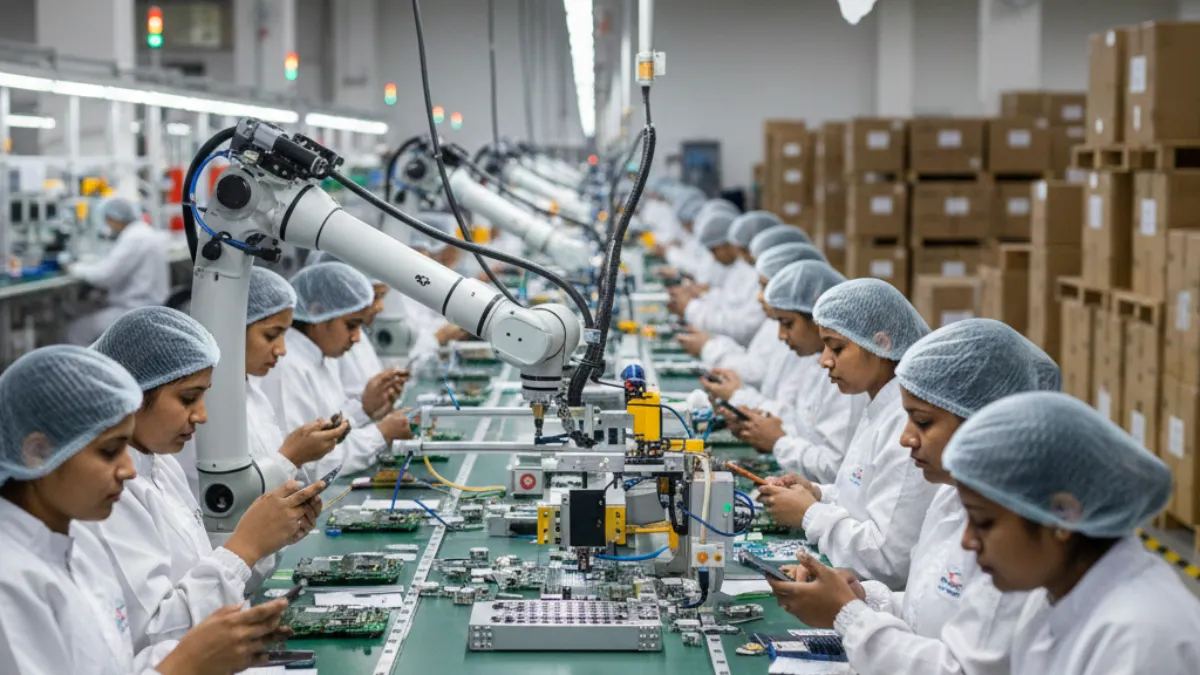
The smartphone manufacturing ecosystem in India has experienced a radical evolution in the last one decade – a peripheral manufacturer to a global giant, which is currently leading smart phone exports to major markets such as the United States of America. This change is backed by specific government policies and significant investments by the world leaders of technology and is an indication of a new era in the industrial and technological aspirations of India.
Record Growth in Exports
It is expected that India will reach a historic breakthrough in 2025, surpassing China as the supplier of smartphones to the United States. By the second quarter of 2025, the proportion of the phones imported into the United States of America labelled Made-in-India was 44 percent versus 25 percent in China; a drastic turnaround to the previous year when China had a 61 percent share while India had 13 percent.
According to Indian government data, smartphone exports india have shot up in terms of value and quantity with the phone shipments amounting to over 1 lakh crore (about USD 12 billion) up to the 2025 fiscal year.
The Role of the Production-Linked Incentives (PLI)
The government has initiated the Production-Linked Incentive (PLI) scheme, which is at the core of the success of the manufacturing industry in India, introduced in 2020. Within the framework of this program, manufacturers are provided with financial assistance depending on the volume of production and the export rates.
Since the roll out of the PLI scheme:
- There have been thousands of employment opportunities in electronics production.
- Exports were gradually increasing with more than 150,000 crore (approximately USD 17.8 billion) of smartphone deliveries being registered in the period between April 2024 and January 2025.
- Such large industry participants as Apple contractors (Foxconn, Tata Electronics, Pegatron) and Samsung opened new plants in India, turning the country into the center of world supply chains.
The global companies which want to diversify their production other than China have found India as an attractive destination in this incentive structure.
Global Technology Leaders Increase their Indian presence
Apple
Apple has played one of the key roles in the export boom in India. The high percentage of iPhones manufactured in India are to be sold in the foreign markets, particularly the U.S., in the near future, which highly reflects the increasing presence of India in the Apple supply chain plan.
Samsung, Motorola & Others
Samsung and Motorola also boosted their production in India to export the same but slower than Apple. India is not only being used by Chinese brands and other global companies to assemble their products but also to export to African markets, West Asia and many more.
Manufacturing Milestones
India has taken significant steps in the electronics industry:
- More than 300 smartphone manufacturing plants are currently present in the country – this is a huge increase in comparison to the two factories ten years ago.
- The domestic production value has increased by hundreds of thousands of crores as compared to 2014 when it stood at approximately 18,900 crore.
- Value addition is no longer a distant goal, and India has already become more than 20 percent of the parts of some phones: in a few years, this figure has increased very fast.
Such accomplishments are indicators not only of additional assembly lines but also greater involvement in global electronics supply lines.
Economic and Strategic Effect
Supply Chain Diversification on a Global Scale
The international tensions and increasing tariffs on the Chinese imports have compelled the manufacturers to seek alternative destinations and the Indian policy environment coupled with the enhancement in infrastructure has placed it in a good position to gain. This makes multinational firms less risky and it enhances the presence of India in the world of tech manufacturing.
Jobs and Industrial Growth
The smartphone manufacturing industry is a system that sustains hundreds of thousands of jobs both in assembly lines and parts suppliers. It also supports the investment in the ancillary sectors such as packing, logis and electronic parts – enhancing the overall growth of the economy.
What’s Next for India?
Looking ahead, India aims to:
- Increase the manufacturing of electronic components and semiconductors in the area and decrease the use of imports. The past national budgets have also allocated a substantial amount of funds towards this objective.
- Further promote domestic and foreign investment in high-technology.
- Enhance competitiveness of exports by provision of incentives and infrastructure.
- Make in India smartphones
Conclusion
The transformation of India into the major exporter of smartphones in the world is the history of strategic policy making, the fast development of the Indian industry, and the further direct contact with the world of multinationals supply chains. One of the fastest developing pillars of electronic production in the world is now India with sustained momentum, and sustaining support to innovation and manufacturing.