




It is not merely a high-resolution chip but rather a stacked system consisting of hardware and Artificial Intelligence (AI) that is built right into the sensor, the Sony LYTIA 901. The new architecture addresses the old trade-offs of resolution, sensitivity and zoom quality.
Sony LYTIA 901: The 200MP Revolution: Breakdown
Key Specifications
The performance begins with the physical design of the sensor, which determines the initial way of capture of light.
| Model name | LYTIA 901 | |
| Image size | 1/1.12-type (diagonal 14.287 mm) | |
| Effective pixels | Approx. 200 megapixels | |
| Unit cell size | 0.7 μm × 0.7 μm (H × V) | |
| Color filter | Quad Quad Bayer Coding | |
| Maximum frame rate (all pixel AF) | 200M (4:3) | 10 fps (Full RAW) |
| 50M (4:3) | 30 fps (2×2 Bin) | |
| 12.5M (4:3) | 60 fps (2×2 Bin Crop, AD12 split-HDR / 4×4 Bin, DCG-HDR or LBMF) | |
| 8K4K (16:9) | 30 fps (2×2 Bin) | |
| 4K2K (16:9) | 120 fps (4×4 Bin) | |
| Power supply | Analog | 2.8 v/1.8 v |
| Digital | 0.82 v | |
| Interface | 1.8 v or 1.2 v | |
| Output interface | MIPI® C-PHY 2/3 trio, Max. 6.0 Gsps/trio MIPI D-PHY 2/4 lane, Max. 2.5 Gbps/lane | |
The Quad-Quad Bayer Coding (QQBC)

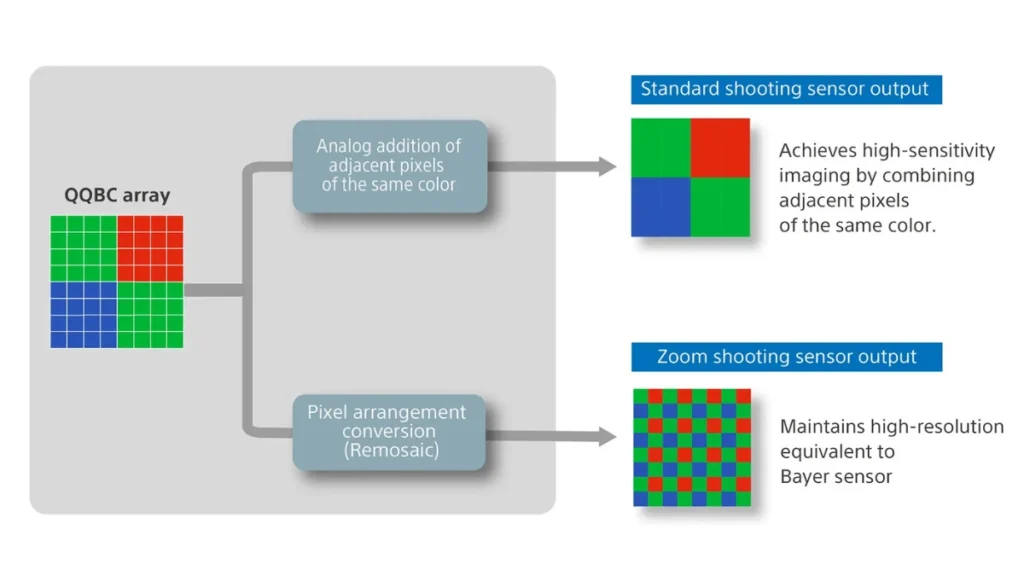
This is the fundamental pixel layout which balances the trade-off between light sensitivity (high light) and full resolution (high detail/zoom).
- Pixel Grouping: Pixels that are 16 adjacent pixels (4×4 array) are grouped by a single identical color filter (Red, Green or Blue) by the sensor.
- Standard Mode (Low Light/Night): In normal and low-light photography, the output of all these 16 pixels is merged (binned) together into a single, huge pixel of 2.8μm (which produces a 12.5MP final image). This aggregation allows maximum light sensitivity, and it limits noise considerably and enhances performance in low light conditions.
- High-Resolution Mode (Zoom/Detail): When the camera requires the maximum detail (e.g. when working with a 2× or 4× zoom shot) the system has to use the full 200MP resolution.
On-Sensor Artificially Intelligent Learning-Based Remosaicing
This is the most important and the first in the industry of Sony LYTIA 901.
- The Processing Challenge: The remosaicing process, needed to go out of the 16-in-1 low-light mode, to the high-resolution, 200MP array (the 200-megapixel process) would need enormous real-time computing resources, particularly in video.
- A dedicated AI learning-based processing circuit is built into the sensor logic (a portion of the stacked design): Sony has implemented a dedicated AI learning-based processing circuit within the sensor logic.
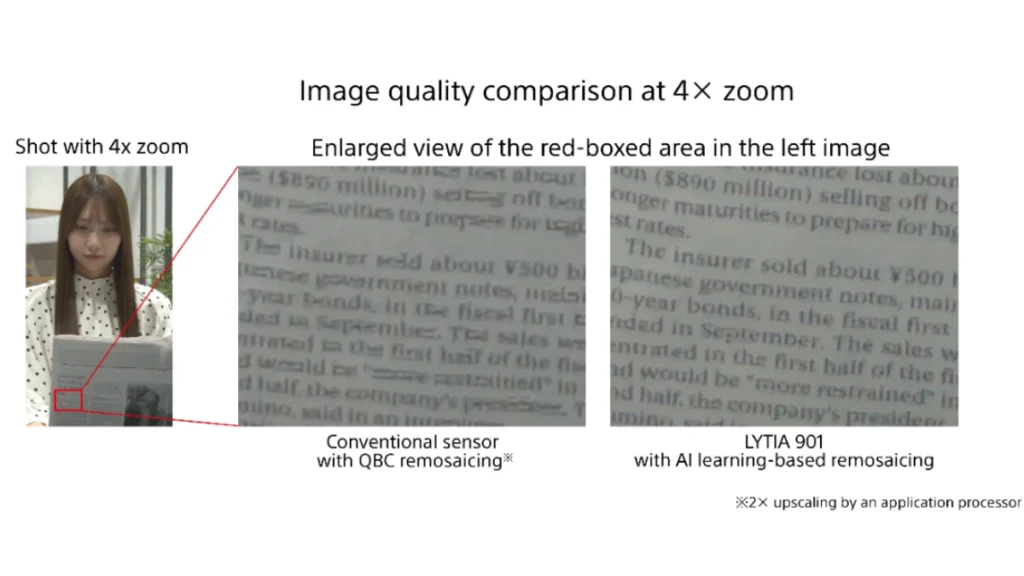
- Result: 4x Lossless-Quality Zoom: This on-sensor AI is able to process the complicated reconstruction of the pixel data much more efficiently and more precisely than an external image signal processor (ISP). This allows 4x in-sensor zoom (ISZ) that continues to preserve incredible fine detail (such as patterns and text) and color accuracy, even at 4x video recording at 30fps. It has the ability to simulate the performance of a professional optical zoom lens.
Comparison of Image Quality on 4x Zoom
Summary of Impact
To put it briefly, the Sony LYTIA 901 leaves the mobile photography in the old-fashioned trade-off dilemma:
- Low-Light Performance: Excellent, as it has 16- in-1 pixel binning.
- Resolution/Detail: Outstanding, because of 200MP count.
- Zoom Quality: Revolutionized, 4 in sensor zoom made by on-chip AI processing.
The sensor will be driving the next generation of flagship smartphones to enable them to provide DSLR-quality results with one primary camera module.
Also Read: Mixpanel Scare: OpenAI Gives 3 Crucial API Details