
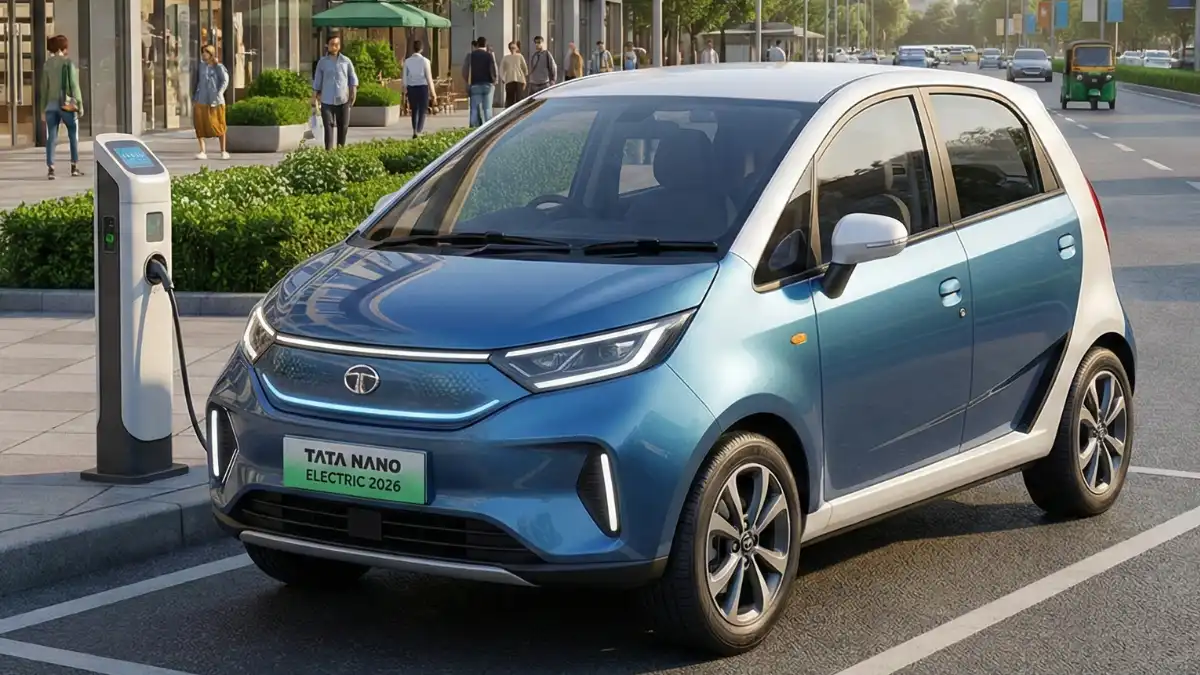
Tata Nano Electric 2026:Remember the Tata Nano? The little car that dreamt big and promised to put every Indian family on four wheels is gearing up for a massive comeback. But this time, it’s ditching the petrol engine for something much more exciting: an all-electric powertrain.
Dubbed the Tata Nano Electric 2026, the rumor mill is spinning with wild claims about this upcoming compact EV. If the reports are to be believed, Tata Motors is preparing to launch an affordable, zero-emission urban warrior that could completely disrupt the Indian automobile market.
Priced at a jaw-dropping rumored tata nano ev price starting of just ₹2.99 lakh (ex-showroom), it claims to offer premium features and an unprecedented driving range. Let’s dive into what we know so far, and more importantly, separate the facts from the internet hype.
Tata Nano Electric 2026 Specs: At a Glance
- Expected Price: ₹2.99 Lakh (ex-showroom)
- Claimed Range: Up to 525 km per charge
- Powertrain: 72V Lithium-ion system / 48PS electric motor / 115 Nm torque
- Top Speed: 120 km/h
- Fast Charging: Yes (Significant charge in roughly 45 mins)
A Fresh, Futuristic Redesign
Forget the bare-bones, budget look of the original Nano. Tata Motors has reportedly given the 2026 Electric model a major glow-up. It still keeps its compact, traffic-friendly proportions, but the styling is significantly more premium.
The front fascia proudly displays its electric DNA with a sleek, closed EV grille and sharp LED daytime running lights (DRLs). With smoother aerodynamic curves, dual-tone paint options, sporty bumpers, and 13-inch alloy wheels, this micro-car is designed to look confident and modern on city streets.
Step inside, and the four-seater cabin prioritizes intelligent space management. Gone are the days of the basic dashboard; the new Nano EV reportedly features a touch-enabled infotainment system paired with a fully digital instrument cluster, proving that a small footprint doesn’t have to mean a cramped or outdated interior.
Performance and the “525km” Range Claim
Under the hood, reports suggest the Tata Nano EV will be powered by a 72V high-performance lithium-ion battery and a 48PS electric motor. This setup promises 115 Nm of instant torque, which means you’ll get that silent, vibration-free, and peppy acceleration that EVs are famous for. Drivers will even be able to switch between Eco Mode for maximum efficiency and Sport Mode for quicker overtakes.
But the biggest talking point is the range. The rumors claim a certified range of 525 km on a single charge, backed by regenerative braking and advanced thermal management. If true, this would make the Tata Nano electric car one of the most efficient vehicles on the planet.
Smart Tech on a Budget
Despite the entry-level price tag, Tata Nano EV doesn’t seem to skimp on modern conveniences. According to the leaks, the car will feature:
- AI Voice Assistance: For hands-free control of basic functions.
- Smartphone Connectivity: Seamless integration for navigation and media.
- Remote App Controls: Check your battery status, lock or unlock the doors, and pre-condition the cabin AC straight from your phone.
With flexible EMI options supposedly starting as low as ₹3,499 per month and government EV subsidies sweetening the deal, it’s easy to see why college students, urban commuters, and first-time buyers are getting excited.
The Reality Check
Before you rush to the dealership with your ₹3 Lakh, we need to take a step back and look at these claims through the lens of current automotive realities.
The Price-to-Range Paradox
The idea of a 525 km range for a car priced at ₹2.99 Lakh is, frankly, an engineering and economic paradox. To achieve a true 500+ km range, an EV requires a massive battery pack (roughly 40 kWh to 60 kWh). Even with projected 2026 battery prices, the battery alone would cost far more than the entire ₹2.99 Lakh price tag of the car.
What Should You Actually Expect?
Tata Nano EV price: If a ₹2.99 Lakh variant does launch, expect it to feature a much smaller battery yielding a practical city range of 150–200 km (similar to the MG Comet EV). The mythical 525 km figure is likely either an exaggerated rumor or a spec reserved for a heavily modified, much more expensive top-tier variant.
72V Architecture Limitation
The rumors mention a “72V lithium-ion battery.” A 72V system is generally classified as a Low-Voltage (LV) powertrain, which is great for golf carts or low-speed city runabouts, but highly irregular for a car claiming a 120 km/h top speed and massive range. Modern highway-capable EVs usually operate on 300V to 800V architectures to support fast charging and high-speed efficiency.
The Bottom Line
Despite the wild, exaggerated specs floating around the internet, the concept of a Tata Nano EV is exactly what the Indian market needs right now. A safe, structurally sound, and smart micro-EV for under ₹5 Lakh with a 200 km range would be the ultimate city car for grocery runs and daily commutes. If Tata delivers that, it will be a massive commercial success—no mythical 500km range required.