
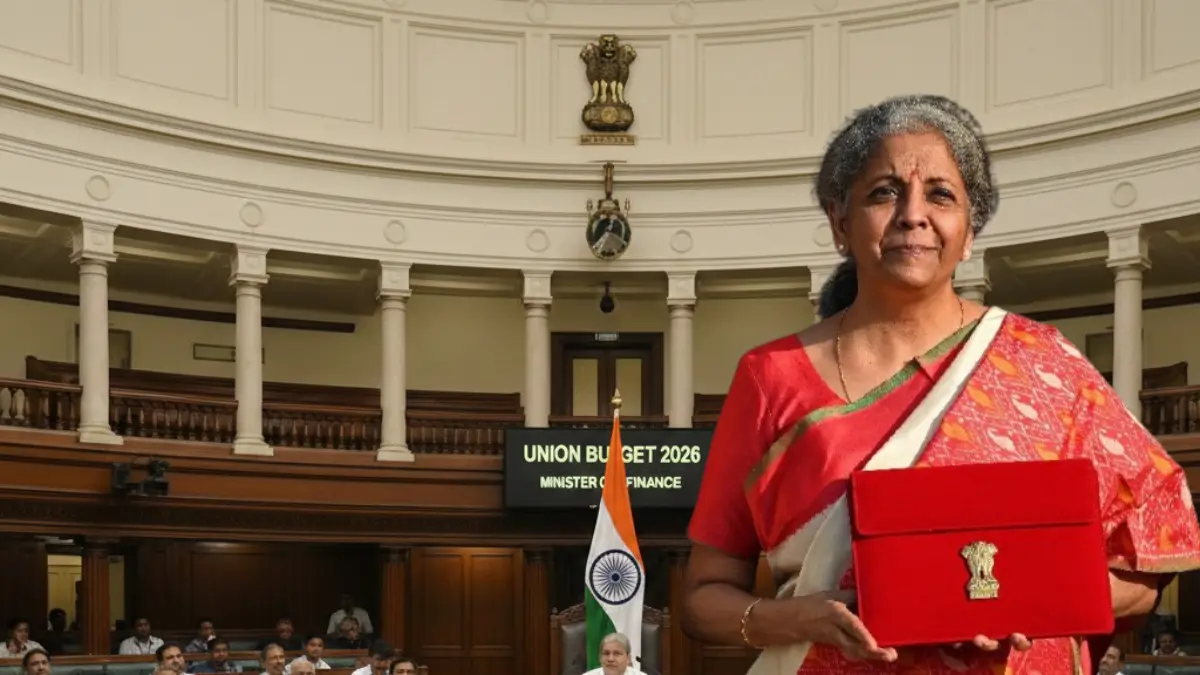
Union Budget 2026-27 was presented by the Finance Minister Nirmala Sitharaman in Parliament and it outlined the economic strategy of the government next year. Its budget concerns the long-term growth, development of infrastructure, industry and manufacturing, employment and the financial control, and stability in the personal taxes.
It is the 9th successive Union Budget given by Sitharaman at the time when India is facing the global economic turmoil in its quest to be one of the fastest-growing major economies in the world.
Budget Theme: Long-term Vision of Stability
Union Budget 2026-27 is a growth-first yet cautious one. The government has opted to boost the economy with increased public investment, structural adjustments and subsidies to the critical areas rather than implementing the eye-catching tax cuts.
Finance Minister pointed out that India growth strategy is anchored on:
- High capital expenditure in the society.
- Increasing manufacturing within the country.
- Increased working places.
- Streamlining rules and regulations.
No Change in Income Tax Slabs
Relief to Stability of Taxpayers
The income tax which was amongst the most observed areas of the budget did not show any alterations in the tax slabs according to both the new and old tax system.
The government has retained:
- Existing income tax slabs
- Existing rebate advantages brought in the past.
- The streamlined taxation system in the new regime.
Such a move is an indication of long-term policy stability and continuity, as opposed to a temporary relief. As others in the middle-class bracket were anticipating new tax cuts, the government reminded the populace that current reforms had already relieved the tax strain on the salaried citizens.
Huge Infrastructure Development Drive
Increased Capital Expenditure To Stimulate Growth
The growth plan of the government is still built on infrastructure. The budget also allocates 12.2 lakh crore on capital expenditure which consolidates the investment in roads, railways, logistics and urban developments.
Priorities in the infrastructure are:
- National highway and expressway development.
- Infrastructure (high-speed rails).
- Enhancing the security of ports and inland waterways.
- Enhanced transport and housing in the city.
The Finance Minister indicated that each rupee used in infrastructure will have a high multiplier effect on employment and investment by an individual.
Production and Technology Boost
Concentrate on Independence and Creativeness
The budget is part of the efforts that India is undertaking in order to transform itself into an international manufacturing and technological giant.
Major initiatives include:
- Enhancing the India Semiconductor Mission (India Semiconductor Mission 2.0) in the context of local chip fabrication.
- Rare earth mineral corridors to decrease reliance on imports.
- More subsidies to electronics, defence manufacture, and the clean energy industry.
These interventions will be meant to help in attracting foreign investment and also generate high-qualified job opportunities in the country.
MSMEs and Startup Support
More Convenient Compliance, Improved Access
Special attention was paid to Micro, Small and Medium Enterprises (MSMEs), and the measures were aimed at:
- Make the process of regulation easier.
- Improve access to credit
- Minimize court battles and fines on small defaults.
With the introduction of business facilitation support systems, the small enterprises will be able to expand particularly in the tier-2 and tier-3 cities.
Women-Owned Businesses and Non-Discriminatory Growth
SHE Marts and Skill Development
In order to encourage women entrepreneurship, a budget established SHE Marts which were specialized markets where products designed by women-led businesses would be sold.
Other initiatives are:
- Ladies development skills.
- Access to loans by self-help groups was made easier.
- Assistance to rural and semi-urban businessmen.
These measures focus on enhancing inclusive development and economic inclusion.
Employment and Education Specialization
India Preparing the Workforce of the Future
The budget strengthens the investing in education and skills with the focus on:
- Training programs associated with the industry.
- Growth of online learning solutions.
- Empowering institutions of higher learning.
The government insisted on the need to match education with new areas like AI, electronics, healthcare, and green energy.
Markets and Financial Sector Measures
The Finance Minister has it that reforms are to be made to deepen financial markets and they include:
- Strategies to enhance the corporate bond market.
- Greater institutional investor involvement.
- Actions to enhance market transparency and stability.
But not all of these market participants responded to the shift in taxation of securities with alacrity.
Discipline in the Fiscal and Economic Perspectives
The increased expenditure caused the government to reiterate its dedication to fiscal consolidation, out of which it intended to maintain fiscal deficit under control, and growth.
The economists see the budget as:
- Populist is not its main approach, which is growth.
- Concentrated on economic sustainability.
- Pro-investment and pro-employment.
India What Union Budget 2026-27 Means
- Taxpayers: Income tax laws are stable.
- Businesses: Infrastructure made it more relaxed and easy to comply.
- Economy: high government spending to maintain growth.
- Future: Focus on production, technology and skills.
Final Takeaway
The Union Budget 2026-27 is a prudent and future-oriented document, which is not driven by incentives of the short run but is focused on economic power. The government has availed infrastructure, manufacturing, and inclusive development as the means of creating a robust base of long-term growth story of India.