
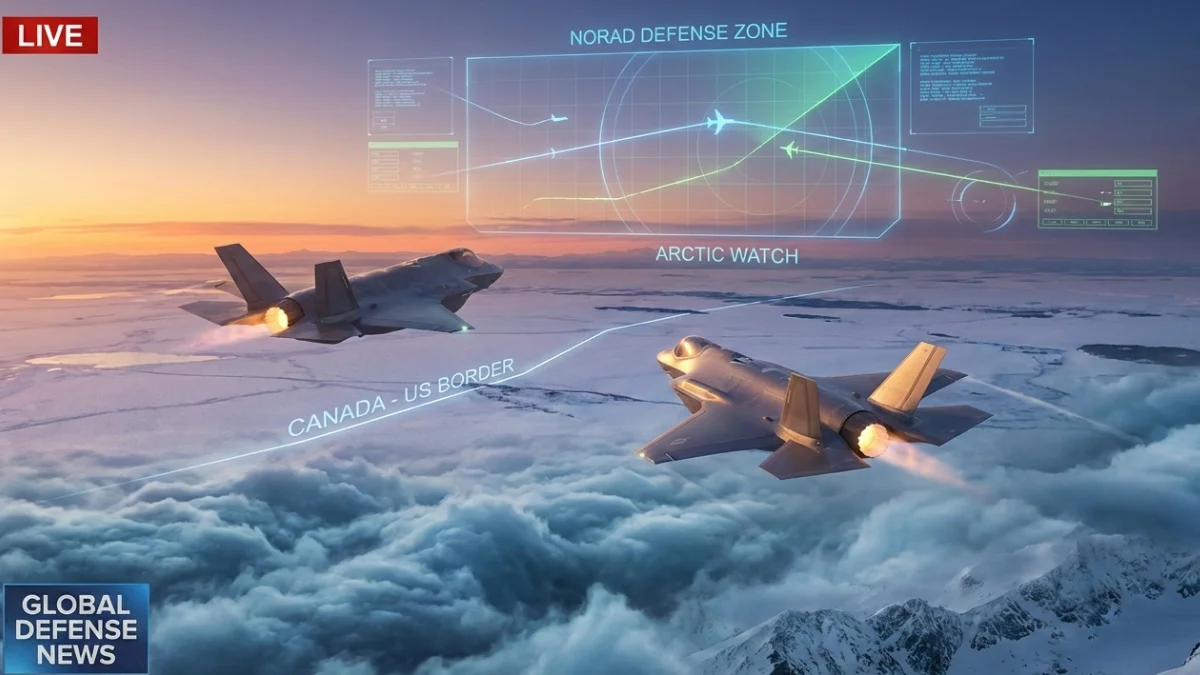
US warns it may deploy fighter jets in Canadian airspace if the F-35 deal stalls. Here are key facts behind the defence tension.
The United States has indicated that it may station more of its fighter jets in Canadian airspace in case Canada decreases or pulls out its intended purchases of F-35 stealth fighters. The alert raises the issue of mounting tension between the two close allies on defence expenditure, security in the airspace and future of joint continental defence.
NORAD Cooperation Under Review
The issue centre is the North American Aerospace Defense Command (NORAD), the old military alliance between US and Canada that has taken charge of the North American airspace. Within the framework of NORAD, the two nations have the shared responsibility of detecting, tracking as well as intercepting any possible aerial threats.
The US argues that the choice made by Canada in its fighter jet fleet has a direct impact on the operations of the NORAD. Canada would have to be compensated by the United States in any case that would reduce their ability to defend Canada through air combat and this could result in more American fighter jets flying over the Canadian controlled airspace.
US Gives Ottawa a Straightforward Warning
US Ambassador to Canada Pete Hoekstra has threatened to reduce the F-35 buy might make Washington reconsider the existing defence policy. He emphasized that the US was not going to leave loopholes in the air defence of continents.
When Canada embarks on a course that removes its capability to fulfill NORAD commitments, the United States must intervene to ensure collective airspace. Hoekstra, in his comments, has attracted a lot of attention in Ottawa.
The quote indicates an increasing impatience among the allies in Washington in defence obligations especially where collective security is set to be entered into.
Canada Reviewing F-35 Deal Which is Expensive
In 2022 Canada signed an agreement with Lockheed Martin to purchase 88 F-35A Lightning II fighter jets, becoming the largest defence acquisition in the history of the country. As the initial tranche of airplanes is already financed, the total expenditure of the program has increased drastically.
The cumulative amount is about 28 billion predicted now as compared to previous estimates. The Canadian government has been compelled by this rise to review this deal and examine the possibility of whether the full fleet is still economically viable.
Alternative Fighter Jet Under Consideration
Canada is also reviewing alternative aircraft as part of the review. One of its competitors is the Saab Gripen, a Swedish-built fighter that the Canadian government has indicated would be partly assembled in the country and would create thousands of jobs in the country.
Nevertheless, the US officials claim that moving away from the F-35 platform would undermine interoperability between the Canadian and American forces, especially when joining forces on a joint operation and rapid response under NORAD.
The Interoperability of a Critical Issue to the US
The F-35 will be the one compatible with the US military equipment, whereby real-time information and intelligence are shared between allied forces. Washington has clarified the need to ensure that this compatibility is preserved in order to have contemporary air defence.
The US officials have threatened that the employment of an alternative fighter jet would pose technical and operational gaps and this would require the US to bear a larger part of the responsibility in keeping North American skies safe.
Strategic Environment and Increased World Threats
The controversy has been launched amid increased international tensions. Over the last few years, NORAD has been scrambling fighter jets more than usual to intercept Russian and Chinese military jets entering the North American airspace, especially around Alaska and the Arctic.
Although these incidents are typically commonplace and take place in international airspace, they highlight the effectiveness of quick reaction and close interaction between the US and Canada.
Us Warns
Canada is also yet to decide whether it will go ahead with the full purchase of the F-35. The military economists believe that Ottawa has to strike a balance between the budgetary pressures, the political interests of the country, and its strategic commitments to NORAD.
In the meantime, the US caution acts as a reminder that military buying decisions go way past national boundaries particularly in cases where continental security is common.