
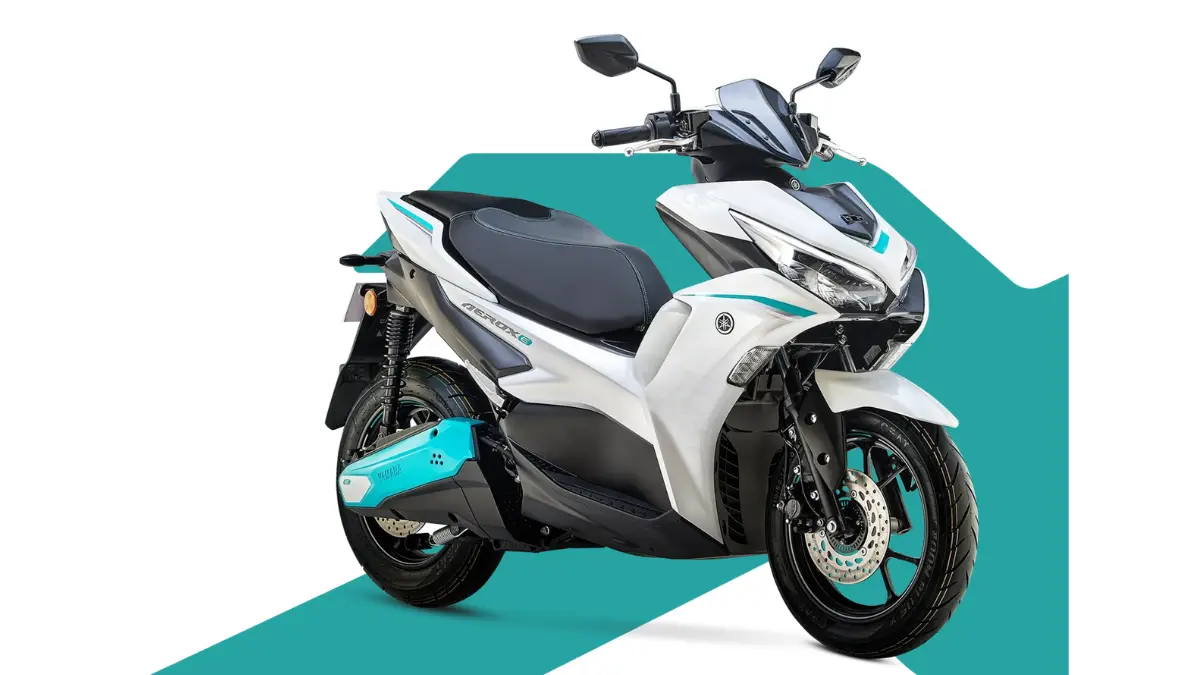
Yamaha Aerox-E Launch: Yamaha has finally taken the wraps off its most anticipated electric two-wheeler for the Indian market, officially entering the premium EV space with the all-new Yamaha Aerox-E. Introduced at ₹2.81 lakh (ex-showroom), this isn’t your typical commuter scooter built to save pennies on the grocery run. Instead, Yamaha is doubling down on what it does best: delivering aggressive styling, sharp handling, and motorcycle-like performance for riders who care about the thrill of the ride.
By utilizing the instantly recognizable, muscular silhouette of the petrol-powered Aerox 155, the Aerox-E bridges the gap between high-performance track heritage and clean, zero-emission urban mobility. It sits comfortably at the top of Yamaha India’s electric lineup, offering a mature, high-tech alternative to purely utilitarian electric models.
Yamaha Aerox-E Launch The Performance Breakdown: Speed, Power, and Punch
If you were worried that switching to an electric battery would dull the Aerox’s sharp edge, the spec sheet should put those fears to rest. The Aerox-E is powered by a robust 9.4 kW peak electric motor that channels 48 Nm of instantaneous torque straight to the rear wheel. Out on the tarmac, that translates to a brisk, seamless surge of power, pushing the maxi-scooter to a claimed top speed of 95.5 km/h.
Because it retains the stiff frame, telescopic front forks, and chunky, large-diameter wheels of its petrol sibling, it promises the same planted, confident cornering dynamics that made the original Aerox a favorite among enthusiasts.
Smart Charging: The Convenience of Dual Removable Batteries
One of the biggest hurdles for urban EV owners is finding a dedicated parking spot next to a power outlet. Yamaha tackles this head-on by equipping the Aerox-E with two removable 1.5 kWh lithium-ion battery packs (giving you a combined 3.0 kWh capacity).
Instead of hunting for a charging station or dragging a heavy extension cord down from an apartment window, you can simply pop the seat, lift the battery packs out, and carry them indoors to charge using any standard wall socket.
- Juicing up a single battery: Takes roughly 3 hours and 10 minutes.
- Charging the full dual-pack setup: Takes about 6 hours and 20 minutes from empty to full.
When both packs are fully charged, the system delivers a certified riding range of up to 117 kilometers under ideal testing conditions. Interestingly, if you ever find yourself in a pinch, the scooter can run on just one battery pack while the other charges inside, though Yamaha notes that top speed and acceleration are automatically dialed back in this single-battery safety mode.
Ride Modes, Gadgets, and On-Board Technology
The cockpit of the Aerox-E feels less like a basic scooter and more like a modern tech hub. The centerpiece is a vibrant 5-inch TFT color display that remains highly legible even under direct Indian sunlight. Through this screen, riders can toggle between three distinct riding profiles:
- Eco Mode: Maximizes battery life for smooth, predictable city crawling.
- Standard Mode: Offers a balanced mix of daily usability and steady power delivery.
- Power Mode: Sharpens throttle response to let the 9.4 kW motor unleash its full potential.
Need an extra burst of speed to complete a quick highway overtake? The dedicated Boost Mode provides a temporary injection of maximum power. Conversely, when you find yourself wedged into a tight, sloping parking space, the built-in Reverse Assist feature makes backing out completely effortless.
Naturally, the scooter comes packed with modern conveniences like a proximity-based Smart Key system, front disc brakes paired with single-channel ABS, and a highly welcome Traction Control System (TCS) to keep the rear tire from spinning out on slick, rain-slicked monsoon roads.
The Practical Compromise: Under-Seat Storage Takes a Hit
Transitioning a scooter chassis from an internal combustion engine to an electric powertrain almost always requires a compromise, and on the Aerox-E, that compromise is storage.
Because the two substantial lithium-ion battery packs live directly under the saddle, the under-seat storage capacity drops from the petrol version’s massive 24.5 liters down to a more modest 15 liters. While it’s perfectly adequate for a rain jacket, your phone charger, and a few small personal items, it will no longer comfortably swallow a large, full-face helmet. It’s a minor trade-off, but one that daily commuters should keep in mind.
Final Verdict: Who Is the Aerox-E Actually For?
Let’s address the elephant in the room: at ₹2.81 lakh, the Aerox-E is explicitly priced as a premium niche product. It launches at a significant premium over mainstream, high-volume electric scooters from home-grown brands like Ola, Ather, Bajaj, and TVS.
Yamaha isn’t trying to win a mass-market price war here. Instead, they are carving out a distinct luxury performance category. The Aerox-E is built for the early adopter, the design enthusiast, and the rider who wants premium Japanese engineering, standout maxi-scooter aesthetics, and sophisticated riding electronics without burning a drop of gasoline. It’s a bold statement piece that proves electric commuting can look, feel, and ride like a true performance machine.