


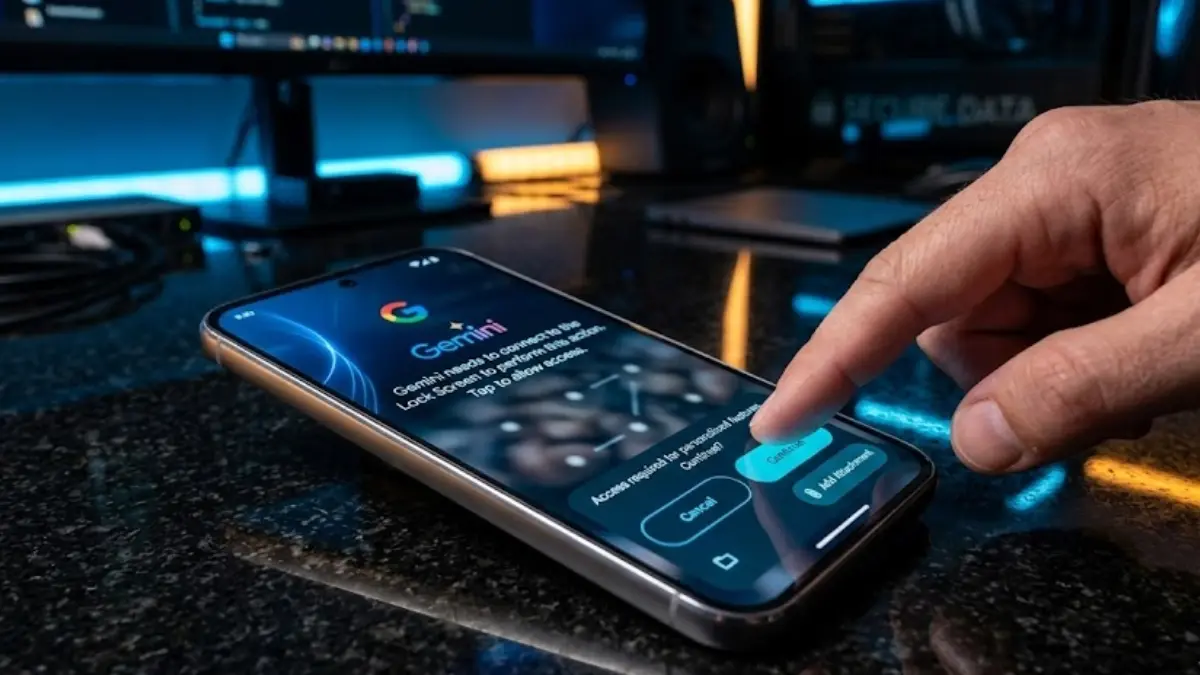


Google is rushing out an emergency patch following the discovery of a critical Android lock screen bug vulnerability. The flaw allows anyone with physical access to a locked device to exploit the Gemini AI assistant, bypassing standard PIN, pattern, or biometric authentication to send SMS messages, make calls, and reconnect restricted third-party applications like WhatsApp.
Android devices that have Gemini integration enabled directly from the lock screen. While the issue came to light prominently on early builds, it presents a significant privacy threat to the broader Android ecosystem, prompting Google to fast-track a security update.
Android Lock Screen Bug
Anatomy of the Bypass: The Multi-Touch Glitch
The bug isn’t a simple software oversight; it relies on a highly specific multi-touch timing exploit that confuses the Android system’s security overlay.
Normally, if a user attempts to use Gemini on a locked screen to interact with restricted apps (like Google Messages), the AI chatbot will stop and prompt the user to unlock the phone. Clicking “Continue” brings up the standard device PIN or biometric prompt.
However, security researchers discovered a glaring loophole:
The Flaw: If an unauthorized user presses the “Continue” prompt at the exact same millisecond they tap Gemini’s “Add Attachment” button, the system suffers a race condition. The security layer fails to render the lock screen, and Gemini processes the command as if the device were fully authenticated.
Once this barrier is broken, the security failure cascades. An unauthorized handler can not only send text messages and place calls, but they can also input commands like @WhatsApp into the Gemini text field. This automatically reconnects the AI assistant to previously restricted third-party messaging apps—entirely bypassing the security protocols designed to protect user data.
What Makes This Vulnerability Different?
This is not the first time Google’s AI assistant has faced lock screen scrutiny. A separate set of bypass bugs plagued Gemini, but those were rapidly patched.
What makes this new vulnerability unique—and particularly dangerous—is that it does not appear to be tied to a specific hardware manufacturer. While testing highlighted the flaw on major devices, a Google spokesperson confirmed it is an OS-level software bug rather than a Pixel-exclusive hardware issue. It is currently unclear exactly how many third-party smartphone manufacturers (such as Samsung, Xiaomi, or OnePlus) are actively vulnerable, but the potential surface area is vast.
| Vulnerability Profile | Details |
| Risk Level | High (Requires Physical Access) |
| Primary Vector | Gemini Lock Screen Integration + Multi-Touch Exploit |
| Impacted Services | SMS (Google Messages), Phone Calls, WhatsApp Integration |
| Patch Status | Fix confirmed by Google; rolling out within the week |
Google’s Response and How to Protect Yourself
The good news is that the fix is already built. A Google spokesperson confirmed that the tech giant has successfully reproduced the bug, isolated the cause, and implemented a permanent software fix. The patch is scheduled to roll out to affected devices via an over-the-air (OTA) update.
Because the exploit requires physical access to your smartphone, the average user is not at risk of remote hacking. However, if you frequently leave your phone unattended in public spaces, offices, or shared living environments, you should take immediate action.
Temporary Mitigation Strategy
Until the official update lands on your device, the safest move is to entirely disable Gemini on your lock screen.
- Open your device Settings.
- Navigate to Google -> Gemini (or Apps -> Assistant).
- Tap on Gemini on Lock Screen.
- Toggle the switch to Off or disable “Respond on lock screen.”
Taking these steps ensures that your device remains locked down tight until Google closes the loop on this multi-touch exploit later this week.