


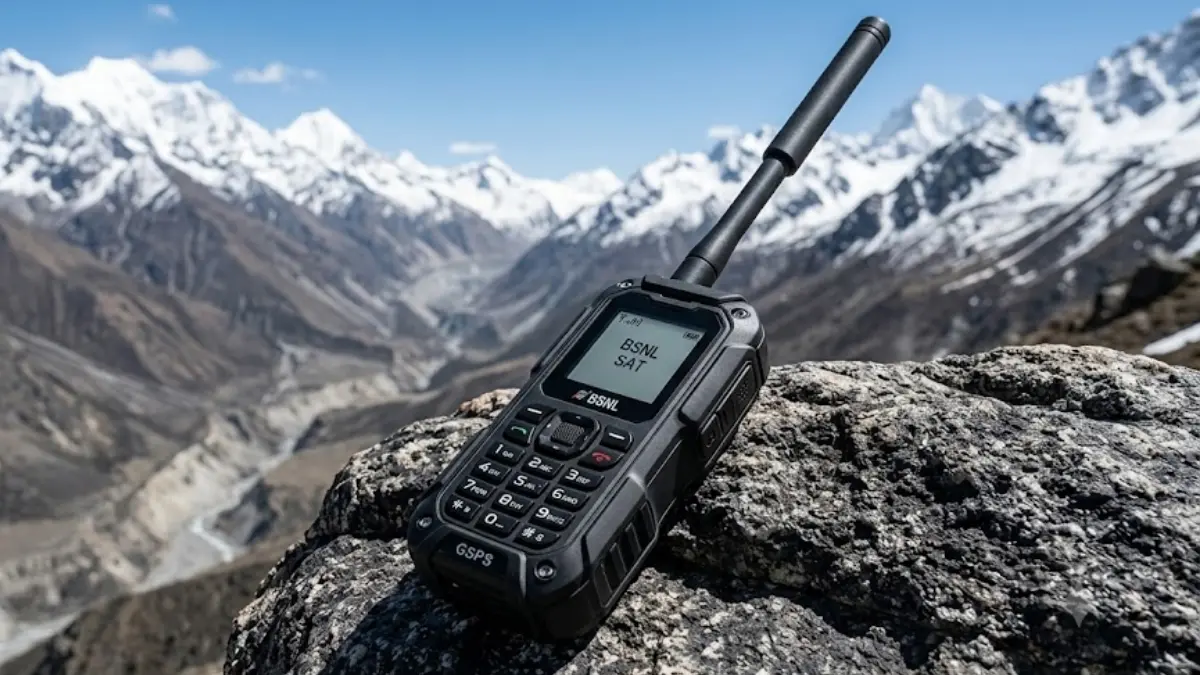


Bsnl Satellite Phone: India’s state-run telecom operator is turning its attention upward to solve a much older problem: total cellular dead zones. Bharat Sanchar Nigam Limited (BSNL) has officially introduced its rugged satellite phone for commercial and institutional buyers. Priced at a premium ₹1.34,166 (inclusive of all taxes), this isn’t your typical smartphone—it is a specialized tool engineered to keep users connected in the absolute harshest environments on the planet.
Bsnl Satellite Phone
By making this hardware available, BSNL is aggressively expanding India’s emergency and remote communication infrastructure. The target audience isn’t the everyday commuter, but rather the defense forces, maritime crews, disaster response teams, mining conglomerates, and extreme adventure travelers who routinely operate outside the boundaries of traditional network towers.
Why Satellites Trump Traditional Towers in Emergencies
Traditional mobile networks are inherently fragile. They rely on local towers that require constant power and physical fiber connections. When an earthquake hits, a cyclone makes landfall, or a remote valley cuts off infrastructure, those towers go dark.
Satellite phones bypass this terrestrial vulnerability entirely by communicating directly with a constellation of spacecraft orbiting thousands of miles above the Earth. BSNL’s latest offering relies on the Global Satellite Phone Service (GSPS) framework, ensuring that voice calls and text messages remain fully operational even if every cell tower in the region is flattened. Furthermore, in compliance with the Department of Telecommunications (DoT) directives, the entire communication network uses heavy, high-level encryption to safeguard sensitive data from interception.
Breaking Down the Costs: Handset vs. Subscription Plans
Operating a satellite phone requires a clear understanding of the financial commitment, which is divided between the upfront hardware cost and specialized usage tariffs. Because these lines are heavily monitored and utilize orbital bandwidth, the pricing structure is split into dedicated government and commercial brackets.
The Postpaid Setup
For organizations that require consistent, predictable billing, BSNL offers three distinct monthly postpaid tiers based on usage needs:
- The Entry Tier: ₹3,500 per month (includes 16 free minutes or SMS).
- The Mid Tier: ₹5,835 per month (includes 30 free minutes or SMS).
- The Premium Tier: ₹11,670 per month (includes 60 free minutes or SMS).
The Prepaid Setup
For long-term deployments, seasonal mining operations, or maritime fleets, annual prepaid plans offer a more practical approach:
- Government Accounts: ₹38,500 per year, bundled with 240 free minutes. Once those minutes are exhausted, out-of-bundle usage is billed at ₹18 per minute or SMS.
- Commercial Accounts: ₹64,185 per year, bundled with 360 free minutes. Excess usage shifts to a higher rate of ₹25 per minute or SMS.
- Top-up denominations can be added in blocks ranging from ₹200 up to ₹10,000 as operational needs scale.
Strict Security Screenings: Who Can Actually Buy One?
Due to the powerful, off-grid nature of satellite technology, owning a handset in India isn’t as simple as walking into a store and handing over a credit card. The Indian government treats satellite communication as a highly regulated security matter.
Every single subscriber must pass through the exact same rigorous verification process used for traditional mobile connections, supplemented by a strict secondary screening. When applying for a connection, you must formally declare:
- The exact geographic coordinates or regions where the handset will be deployed.
- The specific duration of the phone’s intended use.
- The precise nature of the work or purpose the satellite handset will serve.
The Reality of Public-Sector Support
While the hardware rollout is a massive win for India’s industrial and defense sectors, BSNL’s customer service infrastructure is experiencing some initial friction. In its official social media launch, the telecom provider listed a direct mobile contact number to assist buyers with inquiries. However, early users on platforms like X (formerly Twitter) noted that the helpline was entirely unresponsive, a critique backed by early investigative outreach.
For enterprise buyers, security teams, or deep-wilderness expeditions looking to procure this hardware immediately, bypassing the digital helplines and visiting a major regional BSNL commercial office in person remains the most reliable route to navigate the paperwork and secure a device.