
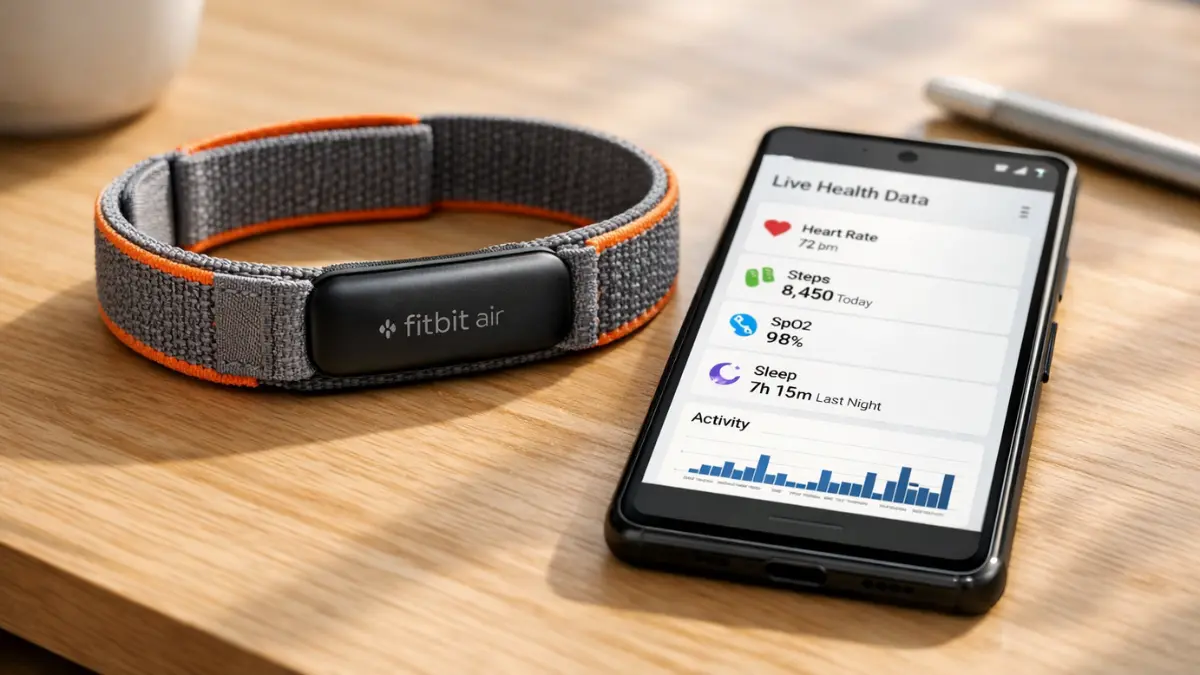
Fitbit Air: For the last decade, the wearable market has felt like a race to see who could strap the biggest, brightest smartphone-mimicking screen to our wrists. But as our pockets buzz and our wrists vibrate with endless notifications, a new trend is quietly taking over: the digital detox. Enter the latest leaks surrounding a device many are calling the “Fitbit Air.” Thanks to a massive treasure trove of data uncovered by Droid Life, we now have a crystal-clear look at Google’s next big bet. And it’s not a smartwatch. It’s a dedicated, distraction-free health companion that looks set to challenge the likes of Whoop and Oura.
The Mystery of the NBA Connection
One of the most fascinating “human” elements of this leak isn’t a technical spec sheet—it’s a celebrity sighting. Sharp-eyed fans noticed a slim, screenless band on the wrist of NBA superstar Stephen Curry during his warm-ups and post-game interviews earlier this year.
At the time, many assumed it was a standard Whoop band. However, the high-resolution renders leaked this week reveal a familiar Fitbit “pebble” sensor tucked into a premium, woven fabric strap. The design is remarkably thin, featuring a textured grey-and-orange finish that looks more like high-end athleisure than a piece of tech hardware.
Fitbit Air Design: Elegance in Absence
The standout feature of the Fitbit Air is, quite literally, what’s missing: the screen. By removing the display, Google has solved two of the biggest pain points in the wearable world: distraction and battery life.
- The Feel: The device is rumored to be buttonless and made from a combination of recycled polyester and high-stretch elastane. It’s designed to be “invisible”—something you put on and forget about until you check your stats the next morning.
- Battery Longevity: Without an OLED screen to power, insiders are whispering about a staggering 14-day battery life. For those of us tired of the “daily charge” routine of the Pixel Watch or Apple Watch, this is a game-changer.
A New Era of “Google Health”
This launch seems to coincide with a massive rebranding effort. The leaks suggest that Fitbit is moving toward a deeper integration with Google Health.
Also Read: The Silicon Valley Brain Drain: Meta Strikes Again at Mira Murati’s Thinking Machines
Since there is no screen to view your heart rate or step count, the heavy lifting moves entirely to your smartphone. The leaked UI shows a sleek “Live Mode” for your phone or tablet, turning your mobile device into a high-def dashboard during workouts. Even more exciting is the rumored integration of Gemini AI, which will act as a personalized coach, analyzing your recovery data and actually telling you why you’re feeling sluggish today, rather than just showing you a bunch of confusing graphs.
Why This Matters for Your Routine
Why would you want a tracker that doesn’t tell you the time? The answer lies in mental clarity.
The Fitbit Air is for the person who wants to track their sleep, heart rate variability (HRV), and stress levels without the constant “ping” of an incoming email or social media alert. It’s about returning to the core of what fitness tracking used to be: a tool for self-improvement, not a digital tether.
Furthermore, with a rumored price point of $99, Google is making a play for the masses. While competitors like Whoop require a mandatory monthly subscription to access your own data, Google appears to be sticking to a “hardware-first” model that could make elite health tracking accessible to everyone.
The Verdict: A Refreshing Reset
The Fitbit Air feels like a “human-centric” design in an increasingly robotic world. It acknowledges that sometimes, the best way to move forward is to strip things back to the essentials.
If the leaks hold true, Google isn’t just launching a new gadget at next month’s I/O event; they are launching a new philosophy on how we live with technology.
Key Takeaways:
- Minimalist Design: No screen, ultra-thin, woven straps.
- Elite Performance: Spotted on pro athletes like Steph Curry.
- Smart Integration: Powered by Google Health and Gemini AI.
- Price: Targeted at a competitive $99.