


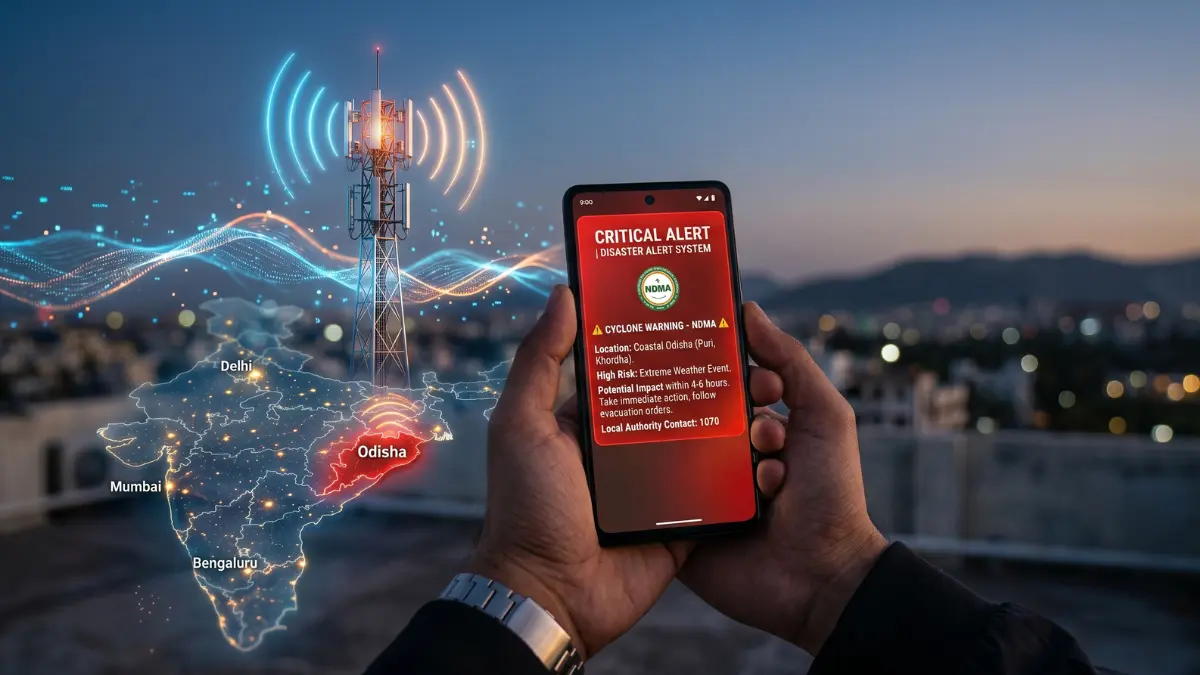


NDMA Cell Broadcast: Imagine a severe storm is brewing just a few miles from your home, or floodwaters are suddenly rising. In those moments, every single second counts. Soon, your smartphone might just be the lifesaver that gives you the crucial extra minutes you need to get to safety.
On May 2, Union Home Minister Amit Shah, joined by Communications Minister Jyotiraditya Scindia, will officially launch India’s brand-new mobile-based disaster communication system. It’s a massive step forward in how the country handles emergencies, shifting the focus from reacting to disasters to actively keeping citizens out of harm’s way.
Here is a breakdown of what this new technology is, how it works, and why your phone might be making some noise very soon.
Moving Beyond Basic Text Messages
We’re all used to getting SMS alerts, but during a major crisis, mobile networks often choke. Too many people try to call their loved ones at the same time, and regular text messages get delayed or fail to deliver entirely.
To solve this, the Department of Telecommunications (DoT) teamed up with the National Disaster Management Authority (NDMA) to build something better. They integrated our existing SACHET alert framework with Cell Broadcast technology.
Also Read: Google Pixel 11 Leak Reveals Powerful Tensor G6 Chipset Upgrade
Unlike a regular text that goes from a network to a specific phone number, a ndma cell broadcast pushes a message to every single active mobile device connected to the cell towers in a specific danger zone. It doesn’t matter if the network is congested, and it doesn’t matter if you have a top-of-the-line smartphone or a basic feature phone—if you are in the targeted area, you will get the alert instantly.
Don’t Panic: Why Your Phone Will Ring on May 2
To make sure everything is running smoothly, the government is conducting a massive real-world test run alongside the official launch.
If you live in any state capital across India, or within Delhi and the National Capital Region (NCR), your phone is going to receive a test alert. The notification will be broadcast in English, Hindi, and regional languages.
Authorities have a simple request for the public: Do not panic.
When the alert comes through, it will read:
“India, launches Cell Broadcast alert using indigenous technology, for instant disaster alerting service for its citizens. Alert citizens, safe nation. No action is required by the public upon receipt of this message. This is a test message.”
If your phone suddenly blares this message, you don’t need to click any links, reply, or evacuate. It is simply a stress test to ensure the system can handle sending millions of notifications simultaneously.
A “Made in India” Lifesaver
One of the standout features of this rollout is that the underlying technology is entirely indigenous. Rather than relying on foreign software to handle sensitive national safety data, India has built and implemented this platform on its own.
While the system is getting its big official launch now, it isn’t untested. It is already operational across all states and Union Territories and has quietly been working in the background, successfully pushing out billions of localized alerts during recent extreme weather events.
Bottom Line Ndma Cell Broadcast
With climate change making extreme weather events more frequent and unpredictable, having a reliable, fast, and fail-proof way to warn the public is no longer a luxury—it’s a necessity. By harnessing the devices we already carry in our pockets every day, this new alert system ensures that when disaster strikes, no one is left in the dark.