
Samsung Galaxy S27 Ultra: If you bought a flagship smartphone, you generally wanted a Qualcomm Snapdragon processor inside it. Samsung’s home-grown Exynos chips had a reputation for getting uncomfortably warm and cutting back on performance—a problem known as thermal throttling—to keep from overheating.
But in a fascinating turn of events, the tables have completely turned. Recent supply chain leaks reveal that Qualcomm is trying to borrow a brilliant cooling trick originally designed for the Exynos line. The catch? Qualcomm is allegedly struggling to make it work, and it could spell trouble for the future Galaxy S27 Ultra.
The Genius Cooling Trick Qualcomm Tried to Borrow
To understand the problem, we have to look at what Samsung’s engineers did right. When building the Exynos 2600, they invented a hardware feature called the Heat Path Block (HPB).
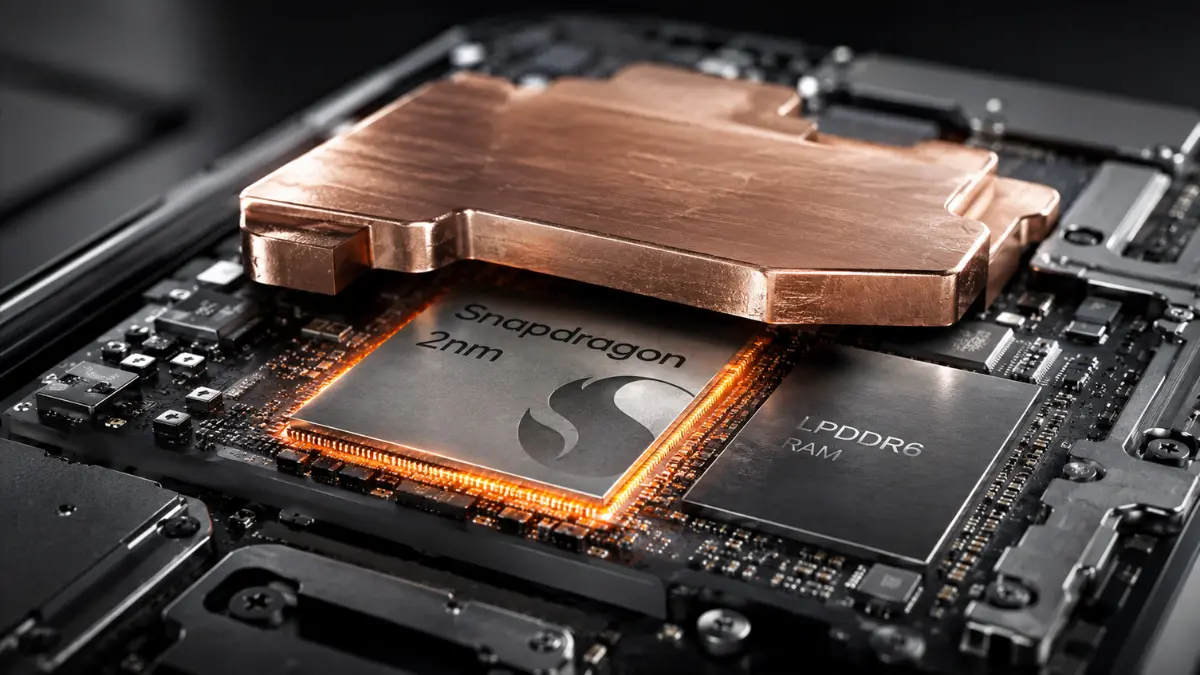
Usually, phone makers stack the RAM (the temporary memory chip) directly on top of the main processor to save space. While this keeps the motherboard compact, it creates a heat trap. Samsung changed the game by moving the RAM to the side, allowing them to place a highly efficient copper heat block directly on top of the main processor. This direct contact drew heat away instantly, lowering temperatures by up to 30%.
Seeing how well this worked, Qualcomm tried to adapt this exact layout for its next-generation powerhouse, the Snapdragon 8 Elite Gen 6 Pro (known internally as the SM8975).
Why Qualcomm’s Version is Falling Short
According to tech insider Reptalica, early testing shows that Qualcomm’s version of this heat block setup simply “isn’t as effective” as Samsung’s native design.
While it sounds simple to just move a chip and slap a piece of copper on top, managing heat at a microscopic level requires incredibly precise materials science and motherboard architecture. Samsung‘s foundry team spent years perfecting the spatial math to make the HPB work seamlessly. Qualcomm, trying to implement it on the fly, seems to have run into a performance wall.
This isn’t just an engineering headache; it’s a big deal for consumers. The Snapdragon 8 Elite Gen 6 Pro is expected to cost phone manufacturers around $300 per chip and is slated to power the premier Galaxy S27 Ultra worldwide. If Qualcomm can’t fix these thermal issues before mass production, the Galaxy S27 Ultra might suffer from aggressive throttling—slowing itself down during heavy 3D gaming or intense on-device AI tasks just to keep the phone from overheating in your hand.
Inside the Next-Gen Snapdragon 6 Lineup
Despite the thermal hiccups, Qualcomm is planning a massive structural upgrade for this generation of chips. They are moving away from older chip configurations to a brand-new 2+3+3 cluster design (2 prime cores, 3 performance cores, and 3 efficiency cores). This layout is specifically built to drastically reduce lag and handle massive data bandwidth.
Here is how the upcoming lineup breaks down:
| Feature | Snapdragon 8 Elite Gen 6 Pro (SM8975) | Snapdragon 8 Elite Gen 6 (SM8950) |
| Primary Target | Premium Flagships (like the Galaxy S27 Ultra) | Standard Flagships and Sub-flagships |
| RAM Capability | Cutting-edge LPDDR6 (Doubles the memory bandwidth) | Standard LPDDR5X (More cost-efficient) |
| Core Speeds | 2 Prime Cores running up to an incredible 5.0GHz | Slightly slower, binned version with one performance core disabled |
| Estimated Cost | ~$300 USD per unit | Significantly cheaper for budget flagship models |
The Bottom Line Samsung Galaxy S27 Ultra
As mobile processors move to the incredibly advanced 2-nanometer manufacturing standard, raw processing speed isn’t the biggest challenge anymore—it’s managing the intense heat generated by these tiny, hyper-fast components.
Samsung seems to have cracked the code on direct-contact cooling, leaving Qualcomm playing catch-up. Qualcomm still has time to tune its hardware before the Galaxy S27 Ultra launches, but for now, the student has definitely not out-schooled the master.