


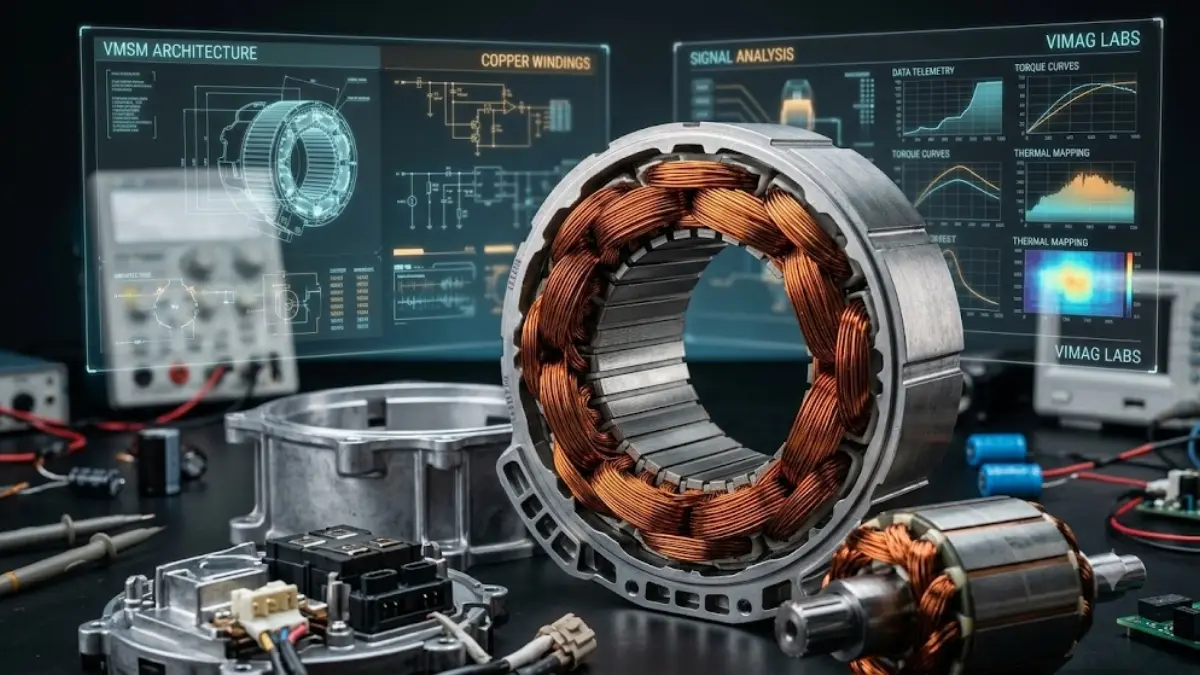


Vimag Labs: By ditching rare-earth materials for intelligent software, the Bengaluru-based startup is solving the electric vehicle industry’s biggest supply chain headache.
Its extreme dependence on rare-earth magnets. The materials required to build high-performance EV motors—primarily neodymium and dysprosium—are notoriously difficult to mine, environmentally damaging to refine, and locked behind fragile, geopolitically volatile supply chains.
Now, Bengaluru-based deep-tech startup Vimag Labs believes it has cracked the code to an entirely independent EV supply chain.
The company recently secured its fifth patent in India for its proprietary Virtual Magnet Synchronous Motor (VMSM) platform. Titled “A Robust Rotating Transformer Excited Synchronous Motor and Its Control,” this latest patent cements the core architecture of Vimag’s software-driven, entirely magnet-free powertrain.
Trading Heavy Metals for Smart Code
Traditional electric cars rely heavily on Permanent Magnet Synchronous Motors (PMSMs). These motors use physical, embedded magnets to generate the magnetic fields needed to turn the wheels.
Vimag Labs is flipping this approach on its head. Instead of relying on physical magnets, their VMSM platform uses advanced power electronics and intelligent control algorithms to simulate and modulate a magnetic field in real time.
What makes this a true engineering feat is that they have managed to pull this off while keeping the motor brushless and free of slip-rings. By removing these high-wear physical components, Vimag eliminates the mechanical friction and maintenance issues that doomed older, historical attempts at magnet-free motors.
“This patent is the outcome of over 87,600 engineering hours,” noted Manish Seth, Co-founder and CEO of Vimag Labs. “It strengthens every dimension of our commercial roadmap — OEM partnerships, licensing, manufacturing scale-up, and future growth.”
From the Lab to the Open Road
Vimag Labs isn’t just playing with theoretical science; they are actively preparing for mass-market deployment. The company has already kicked off commercial pilot programs with prominent two-wheeler and passenger vehicle manufacturers.
Crucially, the architecture scales incredibly well. While consumer cars and scooters are the immediate focus, Vimag is already designing heavy-duty iterations ranging from 200 kW to 600 kW. These high-power variants are earmarked for light and heavy commercial trucks, industrial drive systems, robotics, defense systems, and massive industrial cooling units.
Vimag Labs: Key Growth Milestones
- Intellectual Property: 5 patents granted, with 10 additional patents and 15 trademarks currently moving through the pipeline.
- Financial Backing: Secured USD 5 million in a Series A funding round led by Accel, alongside Chakra Growth Fund and Thinkuvate.
- Production Power: Signed a manufacturing Memorandum of Understanding (MoU) with industrial specialist Jendamark Pvt. Ltd. to scale the VMSM platform for mass production.
Why This Matters for the EV Transition
Automotive giants worldwide are desperately looking for ways to de-risk their component sourcing. By replacing expensive, hard-to-source magnets with localized manufacturing and smart software, Vimag Labs is offering automakers a rare win-win: a way to cut production costs while simultaneously lowering the carbon footprint of building the motor itself.
Backed by fresh capital and a solid manufacturing partnership, this small Bengaluru startup is quietly positioning itself as a foundational architect of tomorrow’s magnet-free transportation ecosystem.