


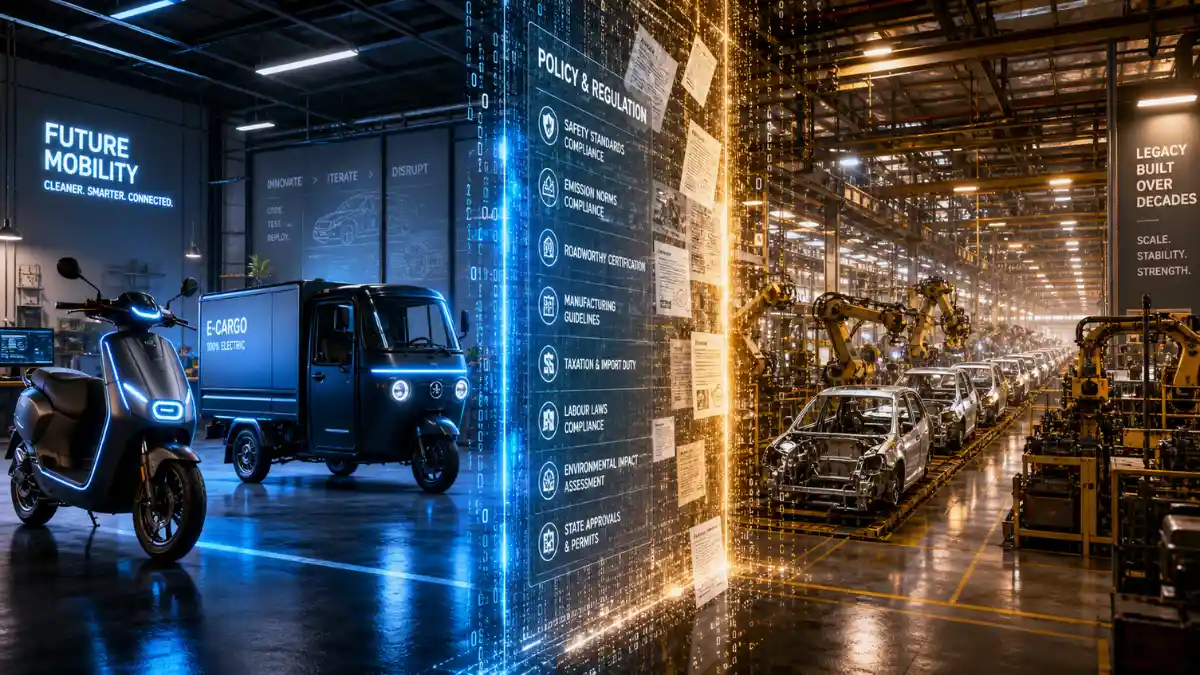


The architects of India’s electric mobility revolution (Auto PLI) are raising a red flag. Their core argument? A government policy meant to boost local manufacturing is inadvertently handing a massive structural advantage to legacy giants.
If you want to understand the irony of India’s electric vehicle boom, look no further than the startups that actually kickstarted it. Early believers who poured money into software, battery tech, and localization—years before the mass market was ready—are now fighting a completely different kind of battle. This time, it’s not against range anxiety; it’s against policy design.
Leading EV manufacturers Ather Energy and Euler Motors have sounded the alarm over their exclusion from the government’s Production Linked Incentive (PLI) scheme for the automobile sector. The exclusion, they argue, is saddling new-age automakers with a crippling 13% to 16% structural cost disadvantage compared to their legacy competitors.
In an industry where margins are notoriously razor-thin, a 16% gap isn’t just a hurdle. It’s a threat to survival.
The Legacy Trap: Rewarding History Over Innovation?
To understand the frustration, you have to look at the rulebook. Introduced in 2021, the Auto PLI scheme was a bold, well-intentioned move to make India a global manufacturing powerhouse.
However, the eligibility criteria were built around one primary metric: existing scale.
Also Read: Ather EL01 Electric Scooter Spied Testing for the First Time in India
To qualify, automakers needed global group revenues exceeding ₹10,000 crore. For non-automotive investors, the threshold was a global net worth of ₹1,000 crore as of March 31, 2021. This meant established giants like Tata Motors, Mahindra & Mahindra, Bajaj Auto, and TVS Motor Company easily breezed through the gates, leveraging the massive balance sheets built by decades of selling petrol and diesel (ICE) vehicles. Ola Electric also managed to qualify under the net-worth category.
But for pure-play, early-stage EV manufacturers who didn’t have decades of ICE revenue behind them? The doors were firmly shut when the application window closed.
“An EV policy architecture that defines champions primarily through legacy scale can create an unintended imbalance. It places emerging EV manufacturers at a 13 to 16 percent cost disadvantage at a stage where they are continuing to invest heavily in capability building.” — Tarun Mehta, Co-founder and CEO, Ather Energy
A “Life or Death” Cost Gap
For startups, every rupee counts. When your competitors are receiving government incentives that effectively discount their manufacturing costs by double digits, playing catch-up becomes exponentially harder.
Saurav Kumar, Founder and CEO of commercial EV maker Euler Motors, didn’t mince words regarding the severity of the situation. “What the current PLI scheme is doing for startups is forcing us to operate at a structural cost disadvantage,” Kumar explained. “This 13-16 percent could mean life or death for a startup.”
The Ask: Calibrate, Don’t Cancel
It’s important to note that neither Mehta nor Kumar is asking for the PLI scheme to be scrapped. They believe in the vision; they just want a seat at the table.
Their core argument is that government incentives should reward intent and execution—deep localization, job creation, and intense R&D—rather than just the historical wealth of a corporation. The Centre for Digital Economy Policy, a prominent tech think tank, has backed the startups, noting that the current architecture overwhelmingly favors large incumbents. If left unchecked, this could stifle the very competitive vibrancy that startups bring to the table.
The Silver Lining: Built Tough
There is, however, a fascinating upside to this struggle. Being locked out of the PLI scheme has forced companies like Ather to build incredibly resilient, lean business models.
While some subsidized peers have fallen into the trap of delaying pricing decisions in anticipation of government handouts, Ather has had to survive on pure product value and operational efficiency. In a recent investor call, Ather’s management noted that operating without these policy-linked safety nets has driven them to create a proactive, highly disciplined path to profitability. They’ve learned to swim with weights on.
What’s Next for India’s EV Ecosystem?
A thriving automotive ecosystem needs both the massive economies of scale that legacy players provide and the disruptive, agile innovation that startups bring. Penalizing the pioneers who absorbed the earliest risks of developing localized EV technology was likely an unintended oversight of the 2021 policy—but it is an oversight that needs fixing.
Fortunately, it seems the government might be listening. Persistent lobbying by startups like Ather, Euler, and River appears to be gaining traction. Reports suggest the Ministry is currently in talks with the Society of Indian Automobile Manufacturers (SIAM) to explore structural adjustments to the scheme, which runs until FY29.
If policymakers can recalibrate the rules to include pure-play EV startups, it won’t just close a 16% cost gap. It will level the playing field, ensuring that the future of Indian mobility is decided by the quality of the technology, not just the size of the bank account.