


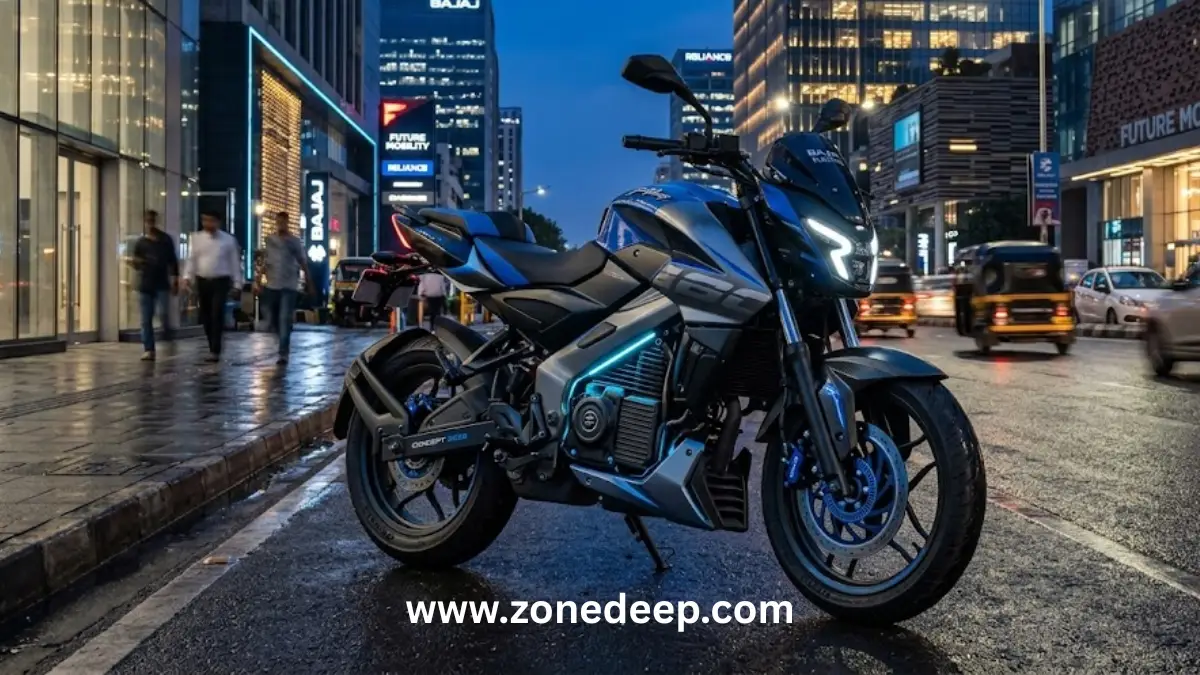


Indian two-wheeler giant Bajaj Auto has officially confirmed that its first electric Bajaj motorcycle is actively under development, aiming for a global debut around Financial Year 2028 (FY28).
The move signals a major strategic step for Bajaj as it expands beyond its successful electric scooter portfolio and enters the emerging electric motorcycle segment.
Bajaj Motorcycle Ev Key Highlights at a Glance
- Launch Timeline: Global debut anticipated in FY2028, with an India launch following in late 2028 or early 2029.
- Export-First Strategy: Bajaj plans to prioritize international markets before introducing the EV motorcycle domestically.
- Production Scaling: Strong Chetak EV demand has led Bajaj to bump monthly manufacturing capacity from 50,000 to 60,000 units.
- Branding & Specs: Technical specs remain under wraps; Bajaj has yet to disclose whether it will launch under the Pulsar badge or create an all-new electric sub-brand.
Global Markets to Get Priority
Speaking during Bajaj Auto’s post-earnings investor call, Dinesh Thapar, Chief Financial Officer at Bajaj Auto, outlined the company’s electric roadmap:
“Development of our electric motorcycle is well underway, with product work progressing steadily. We anticipate a launch around FY28, provided all goes to plan. Our initial focus will be on export markets, followed by the domestic market.”
— Dinesh Thapar, CFO, Bajaj Auto
This export-led roll-out suggests that Bajaj is engineering the motorcycle on a global platform designed to meet stringent international standards before bringing it to Indian shores.
Surging Chetak Demand Powers EV Expansion
The decision to accelerate motorcycle development comes on the heels of strong market momentum for Bajaj’s existing EV offerings. Sales of the Chetak electric scooter and three-wheeled e-rickshaws have grown steadily, prompting the manufacturer to increase overall EV production capacity to 60,000 units per month (up from 50,000 units).
Production Expansion: 50,000 units/mo ➔ 60,000 units/mo (+20%)
Strategic Context & Regulatory Pressures
The FY2028 target aligns closely with evolving regulatory shifts in major Indian urban centers. For instance, Delhi’s proposed EV policy aims to phase out new registrations of petrol and CNG two-wheelers starting April 1, 2028. While Bajaj’s development cycle isn’t tied solely to local policy, the alignment positions the company well for impending clean-mobility mandates.
Competitors like TVS Motor Company, Hero MotoCorp (VIDA), Ather Energy, and Ola Electric are also sharpening their focus on high-performance electric motorcycles, setting up an aggressive battle in the two-wheeler space by 2028.