


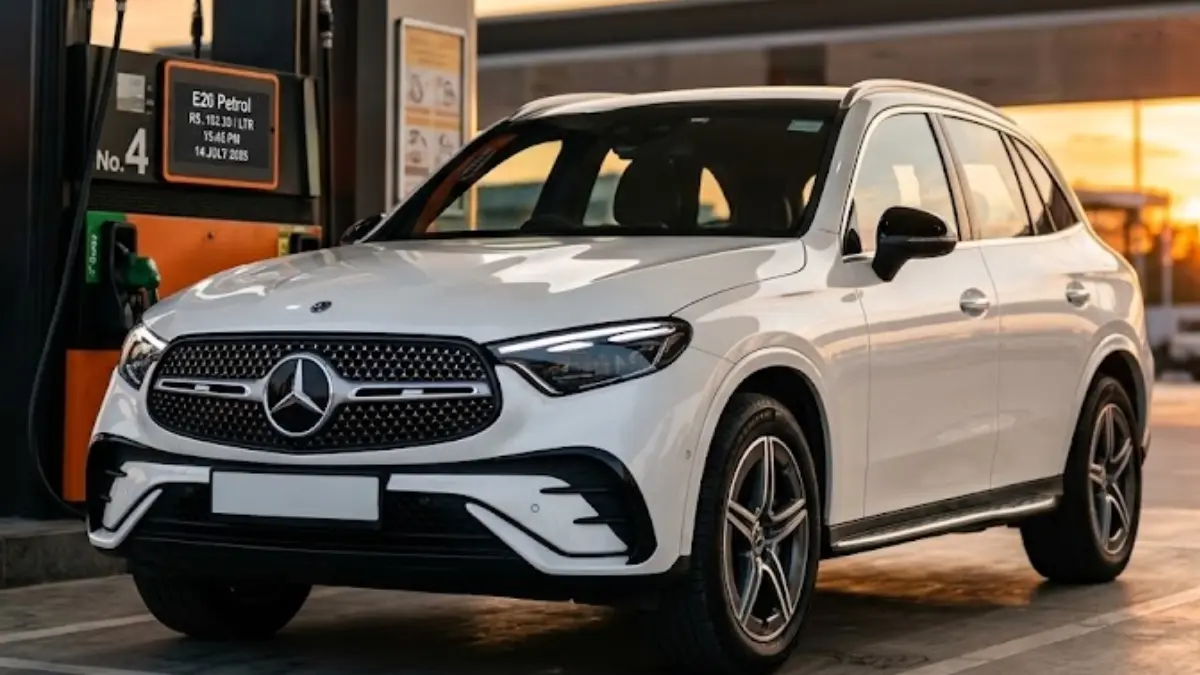


Mercedes Benz E20: Mercedes-Benz has officially broken its silence following explosive online claims that E20 fuel can ruin a premium car’s performance.
The controversy kicked off when one of India’s biggest content creators posted a viral vlog blaming the new 20% ethanol fuel blend for a sudden, massive drop in his luxury SUV’s fuel efficiency. With panic spreading among premium car owners, the German automaker stepped in to clear the air.
Mercedes Benz E20 Fuel
The Spark: A Nightmare Drop in Fuel Economy
Popular YouTuber Saurav Joshi recently shared a video detailing a stressful weekend with his Mercedes-Benz GLC SUV. After pulling up to a regular pump and refueling with E20 petrol, Joshi claimed his luxury ride went downhill fast.
Within just 48 hours, he reported that the SUV’s fuel efficiency plummeted from a healthy 17 kmpl down to a shocking 5 kmpl. On top of that, the vehicle’s estimated driving range on a full tank allegedly nose-dived from nearly 800 km to just 480 km. Visibly worried, the influencer openly questioned whether ethanol-blended fuel is safe for high-end European engines, sparking a wave of anxiety among his millions of followers.
The Manufacturer’s Stance: You Are Fully Compatible
Recognizing how fast the panic was spreading, Mercedes-Benz India quickly issued an official customer advisory. The brand didn’t mince words, stating firmly that customer safety, vehicle reliability, and engine performance remain its absolute top priorities.
Crucially, the luxury automaker clarified that every single BS VI-compliant petrol Mercedes-Benz sold in India is fully certified and materially compatible with E20 fuel.
According to the brand, their modern engines are explicitly engineered to handle the chemical properties of a 20% ethanol blend without any risk of system failure or component degradation. Instead of relying on guesswork or viral videos, the company urged any driver experiencing technical issues to visit an authorized service center for a proper diagnostic check.
The Reality Check: What the Science and Numbers Actually Show
While a drop from 17 kmpl to 5 kmpl sounds terrifying, automotive experts and government data suggest that blaming E20 fuel for a 70% loss in efficiency simply doesn’t hold up mathematically.
It is a known scientific fact that ethanol has a lower energy density than pure petrol. Because of this, an engine does have to burn slightly more fuel to produce the same amount of power. However, that drop is strictly limited.
The Official Benchmark: The Indian government and independent automotive research bodies maintain that E20 is completely safe for compatible vehicles. According to rigorous official testing, the actual reduction in mileage you can expect from E20 fuel is capped at a minor 3% to 5%, depending on your driving habits and traffic conditions.
If a premium car suddenly drops to 5 kmpl, experts point out that something else is almost certainly wrong. The culprit is usually a bad batch of contaminated fuel from a specific pump, an unrelated sensor failure, or an underlying mechanical glitch—not the E20 standard itself.
The Bigger Picture: Navigating India’s Green Transition
This entire situation highlights the growing pains of India’s aggressive push toward green energy. The nationwide rollout of E20 petrol is designed to cut down harmful tailpipe emissions and help slash the country’s massive crude oil import bills.
To prepare for this, the automotive industry spent years re-engineering fuel lines, rubber seals, and engine computers to withstand ethanol. While consumer skepticism is natural during a major shift, statements from engineering giants like Mercedes-Benz show that the hardware under the hood is well-prepared for the future.