
Samsung has pulled back the curtain on its newest breakthrough in display engineering: New Flex Titanium technology.
Designed to tackle the two biggest complaints of the foldable smartphone era—visible screen creases and fragile displays—this new architecture marks a massive leap forward. By incorporating aerospace-grade titanium directly into the screen’s core layers, Samsung is aiming to make next-generation Galaxy foldables thinner, tougher, and smoother than anything we’ve seen before.
How It Works: The Anatomy of a Titanium Display
Until now, the layers beneath foldable OLED screens have relied heavily on polymers (plastics) to maintain flexibility. While great for bending, plastics lack the mechanical rigidity to fully flatten out a screen or shield it from heavy impacts over years of use.
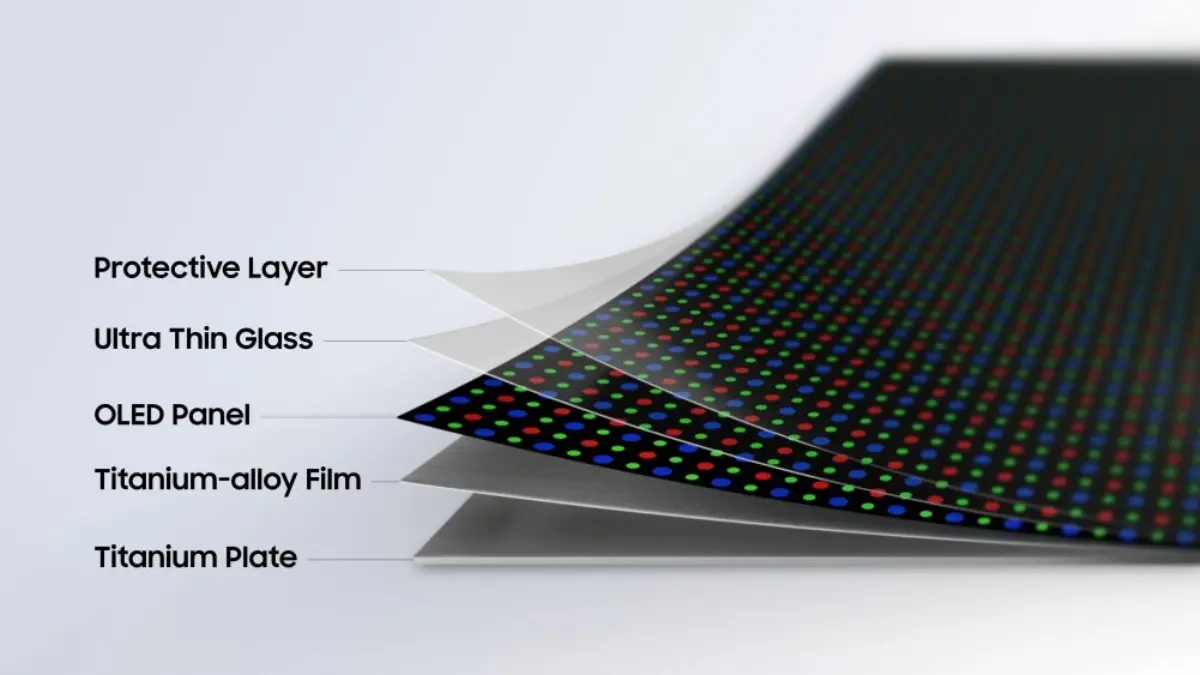
Samsung’s solution is to swap out those flexible plastics for precisely engineered metal layers. As seen in the official display architecture diagram below, the new structure introduces two distinct titanium-based layers directly under the pixels:
New Flex Titanium Technology
1. The Titanium-Alloy Film (Internal Shield)
Positioned directly beneath the active OLED panel, this film serves as the display’s backbone. By replacing standard polymer films with a titanium alloy, Samsung has increased the screen’s internal stiffness by a staggering 20 times. To prevent the metal from making the phone bulky, engineers used an advanced precision rolling process to compress the film until it measures roughly one-third the thickness of a human hair.
2. The Micro-Patterned Titanium Plate (Flex Base)
At the very bottom of the stack sits a robust titanium plate that anchors the entire display module. Historically, micro-gaps between the screen layers and the structural adhesives could create minor unevenness, contributing to the dreaded “screen crease.”
Samsung solved this by using a high-tech hole-processing technique. The section of the titanium plate that sits directly over the phone’s hinge is micro-patterned with microscopic holes. This pattern gives the ultra-rigid metal the elasticity it needs to bend perfectly when closed, while providing a solid, gap-free foundation that pushes up evenly when the device is unfolded.
The Added Value: Why Titanium Changes the Game
| Feature | The Old Way (Polymers) | The New Way (Flex Titanium) |
| Crease Visibility | Noticeable valley over time due to layer stretching. | Drastically reduced; the rigid plate forces a flat plane. |
| Impact Resistance | Soft under-layers offer minimal protection against drops. | High mechanical stiffness absorbs external shocks. |
| Screen Profile | Requires thicker support materials to ensure durability. | Incredibly slim stack thanks to hyper-compressed metals. |
| Power Efficiency | Standard organic materials. | Integrated next-gen organic architecture for lower battery draw. |
Beyond the structural strength, Samsung Display has paired this new metal framework with an updated high-resolution pixel architecture and next-generation organic materials. The result isn’t just a tougher screen—it’s also a brighter, more vivid display that draws significantly less power, extending the overall battery life of the device.
When Can You Get It?
Samsung has confirmed that Flex Titanium technology will officially debut with its next generation of Galaxy foldables. While the company hasn’t named specific devices yet, all eyes are on the upcoming Galaxy Unpacked event, where these next-gen form factors will be fully unveiled to the public.
If the technology lives up to its engineering promises, the era of compromising durability for a folding screen may finally be over.