


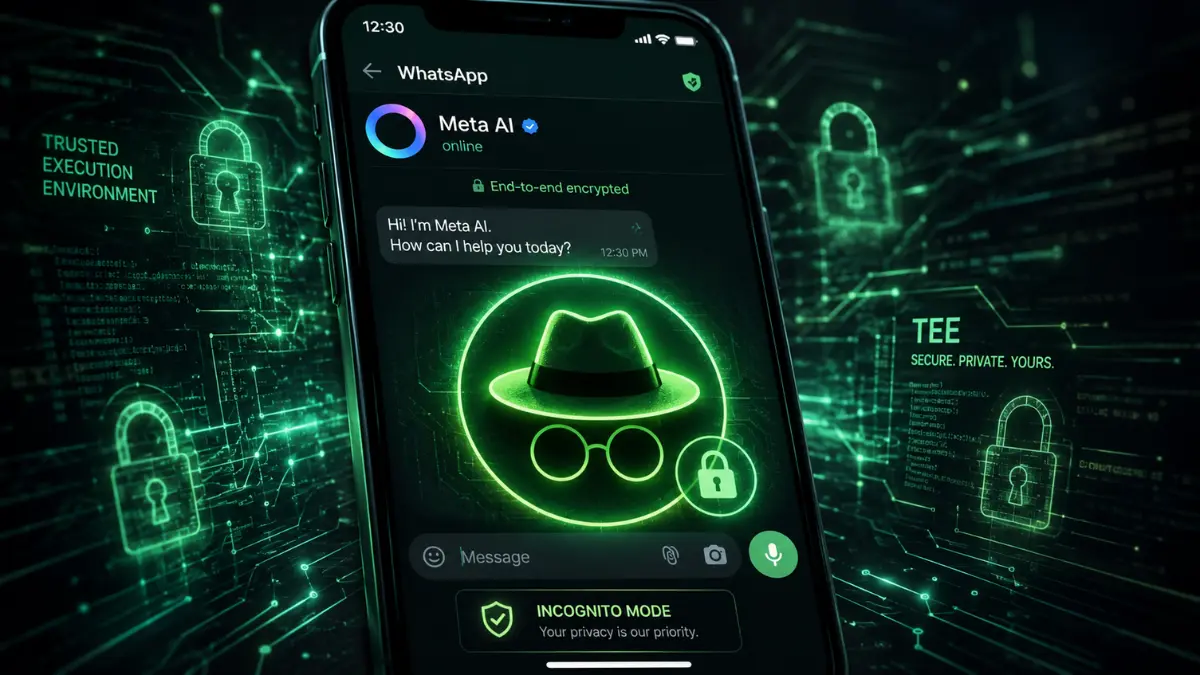


WhatsApp Incognito: Generative artificial intelligence has fast tracked its way into our daily routines. Whether you are using it to draft an awkward email to your boss, plan a tight travel itinerary, or break down complex financial concepts, AI assistants have become our go-to sounding boards. But as these interactions become more integrated into our personal lives, a major question looms large: Who else is reading these chats?
To tackle these privacy anxieties head-on, Meta is rolling out a brand-new feature called Incognito Chat for Meta AI on WhatsApp. Built on a sophisticated backend architecture called Private Processing, this update introduces a temporary, completely confidential mode for your AI interactions.
Here is a closer look at how this feature works, what happens to your data behind the scenes, and why it is a major step forward for user privacy.
How WhatsApp Incognito Chat Works Under the Hood
When you message a friend on WhatsApp, your conversation is protected by end-to-end encryption, meaning only you and the recipient can read it. However, chatting with an AI is a bit different. Because the AI model lives in the cloud, your prompts have to travel to external servers to be processed and answered.
To bridge this privacy gap, Meta is utilizing a highly secure hardware standard known as a Trusted Execution Environment (TEE). Think of a TEE as a digital “black box” inside a secure cloud server.
When you fire up an Incognito Chat session, your data follows a strict, isolated path:
- Secure Transit: Your prompt is heavily encrypted on your phone before it ever leaves the device.
- The Sealed Enclave: The data enters the TEE server. Inside this isolated environment, the AI unpacks your prompt and generates a response. Because the environment is completely locked down, no one—not even Meta engineers or WhatsApp administrators—can see your input or the AI’s output.
- Instant Deletion: The second you close the incognito session, the entire conversation is scrubbed from existence. It isn’t saved to your local chat history, it doesn’t stick in Meta AI’s long-term memory, and it is permanently wiped from the processing servers.
Additionally, if your prompt requires Meta AI to search the web for live information, it does so anonymously. The system strips away your personal account identifiers before forwarding the search request to external search engines, keeping your online identity entirely detached from your queries.
Key Features: When and How to Use It
Using the new mode is designed to be seamless. Users will notice a dedicated incognito toggle right inside their one-to-one chat threads with Meta AI. Tapping it shifts the interface into a visually distinct, dark-themed secure thread that explicitly notes an active private session.
- Ideal Scenarios: Meta highlights Incognito Chat as a safe zone for exploring sensitive, highly personal topics. It’s perfect for researching complex medical symptoms, evaluating career transitions, mapping out personal debt-reduction plans, or even brainstorming surprise birthday proposals that you don’t want populating your regular chat history.
- The Trade-offs: Because this mode prioritizes absolute volatility, standard persistent features—like the /reset-ai command—are disabled by default. It is also worth noting that while your message content is completely destroyed, minimal operational metadata (such as basic connection timestamps) is still logged strictly to monitor server health and prevent platform abuse.
Alongside this rollout, Meta also teased an upcoming feature called Side Chat. Leveraging the same Private Processing technology, Side Chat will allow users to discreetly pull Meta AI into an ongoing group or individual chat to ask quick questions without interrupting the main flow of the conversation.
Big Picture: Why This is a Game-Changer for AI Privacy
Meta’s decision to launch Incognito Chat comes at a critical time. Over the past year, tech companies have faced intense public and regulatory backlash over how generative AI models handle data retention. Many users are hesitant to feed proprietary work data or deeply personal thoughts into chatbots out of fear that their conversations will be used to train future AI models.
Meta itself has dealt with significant platform scrutiny recently, particularly regarding updates to its encryption and data policies across apps like Instagram. By introducing a “zero-retention” environment backed by physical hardware encryption, Meta is trying to set a new standard. While competitors offer simple toggles to turn off or clear chat history, Meta’s TEE architecture attempts to mathematically prove that the service provider cannot look at your data, even if they tried.
The Takeaway
WhatsApp’s Incognito Chat sets a timely blueprint for consumer AI privacy. It successfully balances the massive computational power required by cloud-based AI with the strict, uncompromising privacy boundaries that users expect from a modern messaging platform.
The feature is currently rolling out in phases globally. If you have been holding back from using Meta AI for sensitive, personal, or professional tasks, this update might finally give you the peace of mind to use the assistant to its full potential.